
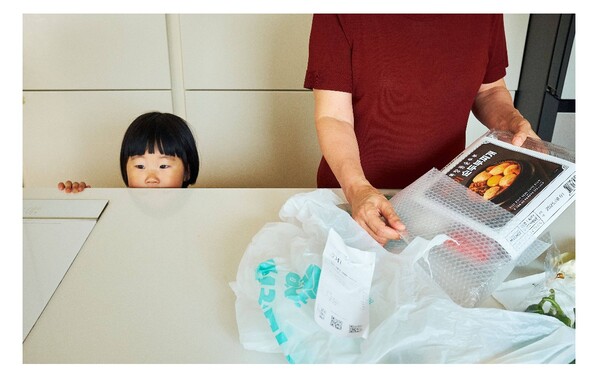
[DigitalToday reporter Shin-hye Ahn] The quick commerce (instant delivery) market is growing rapidly, breaking down boundaries across the retail sector. Convenience stores, supermarkets and e-commerce companies are entering the quick commerce market following delivery apps, and service models are also evolving.
According to global market research firm Statista on Feb. 23, the size of South Korea's quick commerce market surged to 1.2 trillion won last year from 350 billion won in 2020. That is growth of more than 3.5 times over five years, and it is forecast to exceed 5 trillion won this year. The compound annual growth rate is in the 220 percent range.
The convenience store industry is seeing the biggest changes driven by quick commerce. Convenience stores are using their dense nationwide offline store networks as quick commerce hubs. As of 2024, the number of convenience stores nationwide is 18,112 for GS25, 18,458 for CU and 12,152 for Seven Eleven.
Convenience store pickup can be served within 500 metres and delivery can be provided to locations more than 1 km away. That allows expansion of quick commerce services without the burden of opening additional stores. Convenience store operators are actively using their apps, including "WooridongneGS" and "PocketCU".
Recently released indicators of convenience store sales growth show that quick commerce has emerged as a new growth engine for convenience stores.
Last year, quick commerce sales at GS25 grew 64.3 percent from a year earlier. Over the same period, CU's quick commerce sales rose 65.4 percent. The number of delivery items per store is about 10,000 for GS25 and about 8,000 for CU.
GS25 and CU are teaming up with existing quick commerce operators, including Baedal Minjok and Coupang Eats, to enhance delivery competitiveness.
Since December last year, GS25 has been working with Baedal Minjok to develop and launch products tailored to quick commerce. It focused on the fact that 40 percent of sales for its ready-to-bake pizza products come from delivery and pickup services. CU is collaborating with platforms including Naver Jigeum Delivery and Coupang Eats. In November last year, it joined Coupang Eats' "Grocery Shopping" and began delivery and pickup at 1,000 stores in Seoul. It plans to expand to about 6,000 stores nationwide.
Baedal Minjok, a leader in the quick commerce market, is widening delivery items through groceries and shopping to secure competitiveness in quick commerce. According to the industry, Baemin's groceries and shopping division, including Baemin B Mart, recorded a monthly all-time high in December last year. Baemin groceries and shopping delivers in about 30 minutes after an order is placed. Over the same period, monthly visitors were about 5.63 million, up 30 percent from a year earlier.
Baemin groceries and shopping includes Baemin B Mart and major South Korean retailers such as GS25, CU, E-Mart and Homeplus. This has made it possible to expand quick commerce product categories to fresh food and daily necessities, along with fast delivery of about 30 minutes, which has been a key competitive edge of quick commerce.
Supermarkets are no exception. SSG.com plans to strengthen its quick commerce competitiveness by expanding its "Baro Quick" logistics hubs to 80 locations nationwide by the end of this month. SSG.com delivers products from E-Mart stores within about 1 hour within a 3 km radius. With E-Mart offline stores nationwide as hubs, it will run Baro Quick nationwide in 17 locations in Seoul, 27 in Gyeonggi, 2 in Gangwon, 5 in Chungcheong, 9 in Jeolla, 18 in Gyeongsang and 2 in Jeju.
As the quick commerce market is expected to continue growing, quick commerce strategies that leverage strengths by industry are also expected to become more segmented.
An industry official said, "Recently, the quick commerce market has reached a point where services can be offered as long as there is an offline base, regardless of whether a company has its own logistics centres." The official added, "Competitiveness can also be secured through an online-for-offline (O4O) approach using a company's own app, so quick commerce service models are expected to become more segmented."
 Shin-hye Ahn
doubletap@d-today.co.kr
Shin-hye Ahn
doubletap@d-today.co.kr