
South Korea's Ministry of Trade, Industry and Energy has expanded the M.AX Alliance, a consultative body for manufacturing artificial intelligence transformation, to 11 subcommittees with more than 1,300 companies and institutions within six months of its launch.
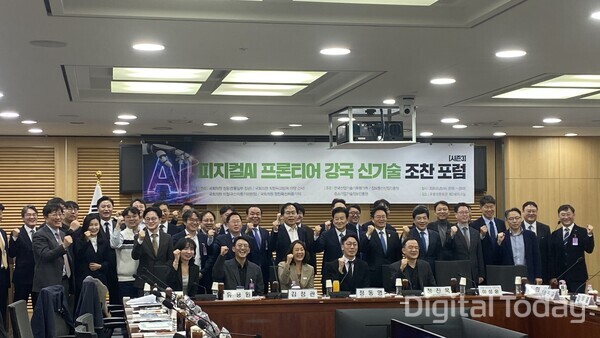
Kim Seong-yeol (김성열), head of the ministry's Industrial Growth Office, said this on March 25 at the 'Physical AI Frontier Powerhouse New Technology Breakfast Forum' held in Seminar Room 2 of the National Assembly Members' Office Building in Yeouido.
Kim said the working-age population is shrinking and labour productivity is markedly low compared with advanced countries. He said China is moving beyond catching up and is pulling ahead in electric vehicles, shipbuilding, batteries, robots and AI. He said relying only on the current situation would leave South Korea behind in the future manufacturing economy.
He cited converting tacit knowledge on factory floors into data as a key task. Kim said master craftsmen are disappearing from an auto parts factory in Daegu and a foundry site in Seongsu-dong. He said the ministry will push to build a "manufacturing digital library" so that skilled workers' know-how can be secured through robots and data and used by young startups to develop AI models.
It also plans to expand humanoid robot pilots. The ministry aims to increase them from 10 sites last year to at least 30 sites this year. Priority targets include hazardous tasks or work that is difficult for people to perform, such as shipyard welding and transfers at logistics warehouses.
Kim said the M.AX Alliance is a necessity, not a choice. He stressed that he would prevent a situation in which factories have to close because there are no people.
In a keynote speech earlier, Industry Minister Kim Jeong-gwan (김정관) said that if Physical AI is made in the United States, M.AX is made in South Korea. He stressed that more than 1,000 companies joined voluntarily because manufacturing AX is a matter of corporate survival.
At a discussion session, participants voiced on-the-ground concerns. Kim Min-gyu (김민규), CEO of BigWave Robotics, said Chinese companies distribute humanoids simultaneously to 30 to 50 countries as soon as they make them. He stressed that companies should not wait for perfection and should pursue an overseas expansion strategy at the same time, as the products are already competitive.
Pyo Yun-seok (표윤석), chief technology officer at Robotis, directly raised the issue of Chinese-made robots entering the market. He said Chinese-made serving robots were distributed domestically with government subsidies during the COVID-19 period, and Chinese products now account for 85 percent of the service robot market. He warned that a channel could open for Chinese-made robots to enter AI data factories indiscriminately. He proposed a policy of granting certification for domestically made humanoids when at least 70 percent of components are domestic and providing subsidies to adopting companies to circulate the ecosystem.
Jeong Young-beom (정영범), executive director at FuriosaAI, said the budget for the on-device AI semiconductor project was cut by about 400 billion won during a preliminary adequacy review process by the Ministry of Economy and Finance. He said a project designed as a national vision is being cut in a way that differs from its objectives during budget evaluation. He said a system is needed to build consensus from policy proposals to budget decisions and on-site execution.
Jeong also urged the government to provide practical purchase support, saying, "Don't just cheer us on. It's time to open your wallet." He said FuriosaAI, which has developed AI semiconductors for nine years, began mass production of its second-generation semiconductors in January and is targeting 20,000 units a year. He said the product outperforms Nvidia counterparts in absolute performance while consuming one-third of the power. He said on-device AI semiconductors take at least 2 to 3 years from design to mass production. He stressed that active adoption at the M.AX Alliance level is needed, as products that can be applied immediately to manufacturing sites such as dark factories are already available.
The forum was hosted by Democratic Party lawmakers Jeong Dong-young (정동영) and Jeong Jin-wook (정진욱), and by People Power Party lawmakers Choi Hyeong-du (최형두) and Lee Cheol-gyu (이철규). It was organised by the Korea Institute for Advancement of Technology, the National IT Industry Promotion Agency and the Korea Technology and Information Promotion Agency for SMEs. Major participating companies included Hyundai Motor, HD Hyundai Samho, NC AI, Kolmar Korea, Korea Aerospace Industries, GeoSoft, Ubifai, EXEM, Clion, Arobot, Tomorrow Robotics, Robotis, BigWave Robotics, Doosan Robotics, Dime Research, OnePredict, WizCore, L&Robotics, FuriosaAI, Mindlogic and Flitto AI.
 Seulgi Son
sageson@d-today.co.kr
Seulgi Son
sageson@d-today.co.kr