
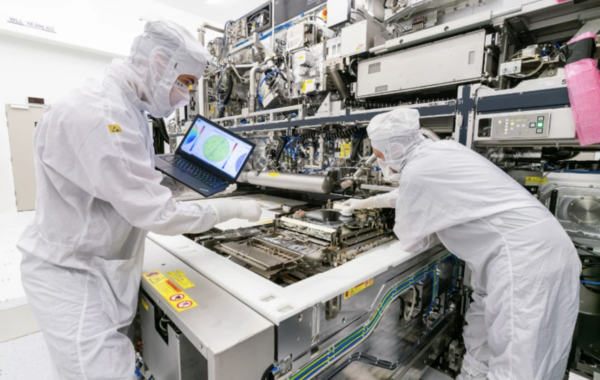
ASML, a maker of extreme ultraviolet (EUV) lithography equipment, has chosen French open-source AI startup Mistral AI as an AI partner. ASML was listed as an early partner for Forge, an enterprise custom AI building platform Mistral unveiled this month.
A company with technological strength strong enough to be dubbed a "super eul" picked a specific AI because of on-the-ground needs. General-purpose AI such as OpenAI is trained on vast amounts of public data. But using ASML's own engineering standards, equipment maintenance manuals or yield data by process can instead cause it to lose context.
If hallucinations that generate plausible but wrong information occur, errors in nanometre-scale ultra-precision processes translate directly into astronomical losses. No matter how smart general-purpose AI is, chip fabs need AI that knows "our factory's language".
Mistral said Forge was designed from the start to bridge that gap. It is a platform that trains AI models directly based on a company's internal documents, code base and operating records. It runs every stage, from pre-training to post-training to reinforcement learning, within a company's own infrastructure. Data does not leave for an external cloud.
After absorbing a company's technical terms and internal workflows, the AI is structured to act as an "operations agent" that selects and executes tools itself and makes decisions according to in-house policies. Besides ASML, Ericsson, the European Space Agency (ESA) and Singapore's Defence Science and Technology Agency (DSO) are participating in building custom models based on Forge.
◆Will South Korea's chip industry and its parts, materials and equipment suppliers move to secure "strategic autonomy"
The semiconductor industry's wariness toward external AI is not limited to ASML. Samsung Electronics banned the use of ChatGPT entirely in 2023. It came right after a security incident raised concerns that semiconductor-related code and internal meeting minutes entered by employees into ChatGPT could be stored on external servers.
Samsung Electronics later introduced its own generative AI, Gauss, and shifted to operating it only on an internal network. It can be seen as a firm direction of controlling external AI while developing internal AI. With Samsung SDS, an affiliate, being the first Korean company to become a reseller and service partner for OpenAI's ChatGPT Enterprise, Samsung Electronics is also likely to roll out its own domain AI.
In a report titled "2026 State of AI in the Enterprise" released early this year, Deloitte said 34 percent of companies worldwide are fundamentally redesigning core processes using AI. It said strategic independence has emerged as an essential factor, beyond simple efficiency gains, in the form of "sovereign AI" that controls AI based on a company's own infrastructure and internal data.
This trend is also being driven by intensifying market competition. Deloitte forecast global semiconductor sales will hit a record $975 billion this year. It expected about $500 billion of that to come from demand for generative AI chips.
As the market grows, pressure on operating efficiency in the equipment and materials sector also rises, ultimately requiring AI internalisation to boost yields and cost competitiveness. An industry official said, "Who internalises security-based, process-specialised AI first will be a new variable in yield competitiveness."
 Daegeon Seok
d2dg@d-today.co.kr
Daegeon Seok
d2dg@d-today.co.kr