
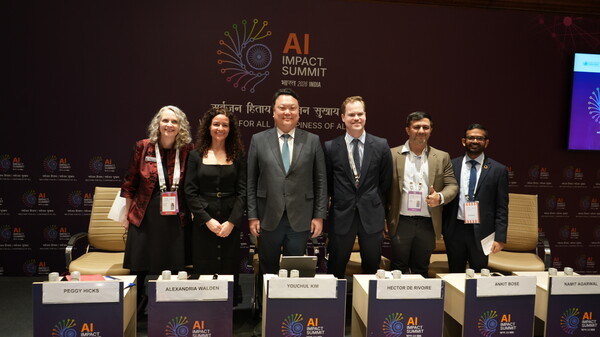
LG AI Research participated in the India AI Impact Summit held on Feb. 20 (local time) at Bharat Mandapam in New Delhi. It shared measures for global cooperation and execution results for building a responsible AI ecosystem.
At the summit, Yoo-cheol Kim (김유철), head of strategy at LG AI Research, held in-depth discussions with key figures from international organisations, academia and industry including UNESCO, the Office of the UN High Commissioner for Human Rights, Google, Microsoft, the National Association of Software and Service Companies, and the World Benchmarking Alliance. The discussions focused on embedding companies' Responsible AI policies and the role of global standards.
Kim unveiled K-AUT (Korea-Augmented Universal Taxonomy), a Korean version of a universal AI risk classification system developed by LG AI Research.
Kim said LG's AI risk classification system was designed on the basic foundation of universal values such as the UN Universal Declaration of Human Rights. He said it was developed to encompass risks that are difficult to capture through universal principles alone, including the legal, social and cultural specifics of Korean society, and potential future risk factors such as collusion among multiple AI agents and bypassing AI safety measures.
The Korean version of the universal AI risk classification system is made up of 4 key areas and 226 detailed risk items: universal human values, social safety, Korean specifics and future risks. It has 5 specific criteria for each item and classifies an AI as having given an inappropriate response if even one violation occurs.
LG AI Research developed the new risk taxonomy as a tool to verify and strengthen the safety of AI models and AI services, rather than a simple guideline. It used the tool to validate the safety of EXAONE, LG's AI foundation model, and is disclosing the results.
The Korean-specific section was designed so that it can be replaced with risk items reflecting the unique specifics of each country and region. That would allow it to be expanded and applied to other countries and regions in the future.
LG AI Research also introduced an AI Ethics MOOC (Massive Open Online Course) project that is set for global release in May.
The programme is a global project being promoted by LG AI Research and UNESCO. It targets AI experts, researchers and policymakers worldwide and aims to strengthen AI ethics capabilities in the public and private sectors by identifying best practices for developing and using AI technology properly and by developing and providing educational programmes.
To that end, LG AI Research disclosed practical operational know-how and AI technologies including an independently developed ethics impact assessment and data compliance AI agents.
It selected 10 global experts from about 450 applicants from 39 countries. It structured the course into 10 modules covering global key agendas including AI ethics foundations, safety, fairness, sustainability and governance.
It is also operating an international advisory committee made up of 15 scholars from global AI research institutions including Harvard University, New York University, the University of Notre Dame, the UN University, the Mozilla Foundation, and the World Commission on the Ethics of Scientific Knowledge and Technology.
Myung-shin Kim (김명신), chief policy officer at LG AI Research, said the project is a bridge that translates global standard principles of AI ethics into the language of the field. He said he expects it to serve as a practical guidepost for experts around the world who feel at a loss in the area of putting AI ethics into practice.
LG AI Research and UNESCO plan to hold a launch event for the AI Ethics MOOC in Seoul in May. The AI Ethics MOOC will be available to anyone free of charge through Coursera, a global online education platform.
LG's move is also in line with Chairman Koo Kwang-mo stressing the importance of compliance in unusually strong terms at a shareholders meeting in March last year.
Koo said a shift in thinking is needed to regard compliance as core infrastructure for corporate growth and development, and that no LG employee can be an exception to that shift. He said LG has made special efforts to ensure compliance takes firm root from top management to frontline business, and will continue to advance its compliance system so it reflects changes in the times and society in a timely way.
 Chi-kyu Hwang
delight@d-today.co.kr
Chi-kyu Hwang
delight@d-today.co.kr