
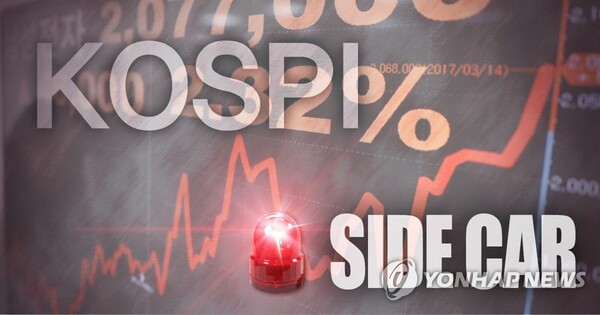
A total of 10 sidecar triggers, which halt the effectiveness of program trading buy quotes, have occurred in the main bourse in less than two months since last month.
With international oil prices surging after a Middle East war and pressure from the exchange rate, sidecars have been triggered 7 times this month alone, prompting some to say the measure has become “routine”.
The Korea Exchange said that after the first sidecar (sell) trigger of the year on Feb. 2, there were four buy-side triggers and six sell-side triggers through the previous day.
Sell-side sidecars were triggered on Feb. 2 and 6, and on March 3, 4, 9 and 23. Buy-side sidecars were triggered on Feb. 3 and on March 5, 10 and 18.
A buy-side (sell-side) sidecar on the main market is triggered when KOSPI200 futures for the nearest month rise (fall) at least 5 percent from the previous day and the move lasts for 1 minute.
The KOSDAQ market has also seen a total of six sidecar triggers this year, including four buy-side and two sell-side triggers.
In the KOSDAQ market, a buy-side (sell-side) sidecar is triggered when KOSDAQ150 futures for the nearest month rise (fall) at least 6 percent from the previous day and the KOSDAQ150 index rises (falls) at least 3 percent, and the move lasts for 1 minute.
The sidecar system was introduced on the main market on Nov. 25, 1996, and on the KOSDAQ market on March 5, 2001.
The current requirement of a move of at least 5 percent from the base price that lasts for 1 minute has applied since May 2001.
In cumulative counts of sidecar triggers on the main market from 2002 through this year, there were 26 in 2008, when the global financial crisis occurred, and this year has the next highest total.
Among the years 2001 to 2026, there were no buy-side or sell-side sidecar triggers in 14 years, including 2005 to 2006, 2010, 2012 to 2019 and 2021 to 2023.
In the remaining years, the total stayed in single digits at 2 to 7 cases, but this year has already seen 10 triggers even though less than three months have passed.
This year, after the KOSPI touched 5,000 points intraday on Jan. 22 and broke above 5,000 at the close on Jan. 28, the index swung sharply in early February under pressure from highs, triggering buy-side and sell-side sidecars in succession.
In March, as domestic and overseas markets were jolted by the fallout from the Middle East war, buy-side and sell-side sidecars have again been triggered one after another.
Circuit breakers, which temporarily halt trading, were also triggered on March 4 and 9 as the KOSPI tumbled on surging oil prices. It was the first time since March 2020, when COVID-19 was spreading rapidly, that circuit breakers were triggered twice within a month on the main market.
As the market repeatedly swings sharply, the securities industry has even circulated an unamused quip that the sidecar has become a “new normal”.
One investor said, “With stock prices going up and down so much, I feel indifferent even when a sidecar is triggered,” adding, “I wonder if this is really the reality of it becoming like a routine.”
Han Ji-young (한지영), a researcher at Kiwoom Securities, said the KOSPI has recently been showing price swings that it did not experience even in past crisis periods. Volatility is significant this month, to the point of seeing a sidecar about once every 2 trading days, she said.
She added that the KOSPI pre-emptively reflected war risks through a plunge of nearly 20 percent in about 2 trading days in the first week of this month, and has been building a bottom in the process. The combination of a sharp fall in stock prices and upward revisions to earnings forecasts is regenerating the appeal of entry in terms of the KOSPI’s forward price-to-earnings ratio valuation, she said.
[Yonhap]
 Online Team
d-today@d-today.co.kr
Online Team
d-today@d-today.co.kr