
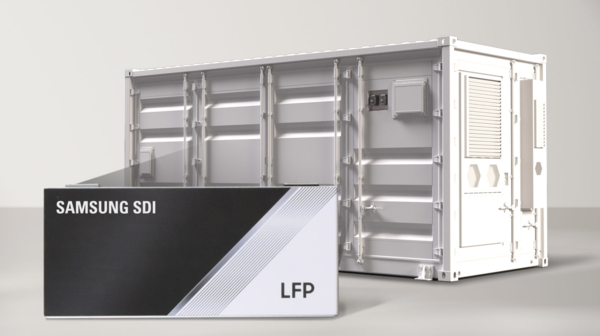
Samsung SDI and L&F joined hands to build a supply chain for key battery materials outside China. Samsung SDI and L&F said on March 24 they signed a mid- to long-term supply contract for cathode materials for LFP (lithium iron phosphate) batteries. The deal is worth 1.6 trillion won. The structure includes fixed volumes for three years from 2027 to 2029, and an option for additional supplies over the following three years.
Samsung SDI will use the LFP cathode materials secured under the contract in battery production lines for energy storage systems at StarPlus Energy (SPE), its joint venture in Indiana. SPE is a joint venture with Stellantis. It has been gradually converting some production lines from electric-vehicle batteries to ESS batteries since the fourth quarter of last year. From the fourth quarter of this year, it plans to mass-produce LFP batteries in addition to existing high-nickel NCA (nickel, cobalt and aluminium) batteries.
Samsung SDI expects the contract to build a domestic-materials supply chain while strengthening its foothold in the North American ESS market. The company recently signed an ESS LFP battery supply contract worth about 2 trillion won with a large U.S. energy development and operations company. It also signed an additional contract worth 1.5 trillion won with a U.S. energy specialist company on March 16.
A Samsung SDI official said, "We signed a supply contract preemptively with a domestic company in line with demand to de-China the materials market." The official said, "Through this contract, we will further strengthen competitiveness in the North American market and create more business opportunities."
Chinese companies currently handle most of global supply of LFP cathode materials. As the U.S. government strengthens origin restrictions through rules such as the prohibited foreign entity (PFE) regulation, securing a supply chain outside China has emerged as a key task for the battery industry. The contract is seen as the first large-scale supply agreement for LFP cathode materials between companies outside China, and is assessed as strategically significant in the supply-chain reshuffle.
L&F began new investment in LFP cathode materials in August last year, the first among companies outside China, and is building production facilities with annual capacity of 60,000 tonnes in two phases. A 30,000-tonne first-phase facility is scheduled for completion in April. After trial runs and customer testing, it will move into large-scale mass production as early as the third quarter of this year. It also plans to swiftly push ahead with a second-phase 30,000-tonne investment to meet volumes under the contract, as a strategy to secure an early leading position in the China-free LFP materials market.
L&F is pursuing a two-track strategy. It will continue mass production of ultra-high-nickel cathode materials based on its technological competitiveness in high-nickel cathode materials, while adding LFP for ESS and mid-to-low-priced electric vehicles as another growth axis. It plans to respond to market volatility through a product lineup spanning high-nickel and LFP, and to expand its portfolio amid the North American supply-chain reshuffle.
L&F CFO Seungheon Ryu (류승헌) said, "We are currently the first company capable of producing LFP materials in regions outside China." He said, "We are actively exploring supply possibilities not only with Korean battery companies but also with overseas automakers and global ESS companies, so we expect the growth trend to continue." He added, "We are planning strategic growth measures such as allocating volumes by customer and expanding additional lines."
 Daegeon Seok
d2dg@d-today.co.kr
Daegeon Seok
d2dg@d-today.co.kr