
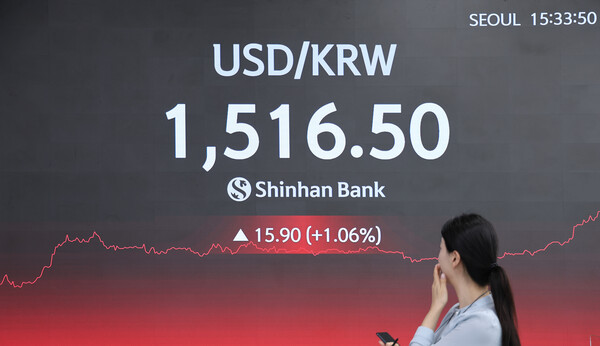
[DigitalToday reporter Ji-young Lee] Anxiety in financial markets is growing as the Middle East war drags on. The won has climbed above 1,500 per dollar and is eyeing the 1,520 level, marking the highest level in about 17 years since the financial crisis.
International oil prices have surged and dollar strength has deepened as geopolitical tensions rise, including Iran's blockade of the Strait of Hormuz and U.S. military pressure.
As the exchange rate rises, foreign outflows are widening and the KOSPI market has also swung, sharply increasing volatility in domestic financial markets.
If the shock from high oil prices continues, a triple vicious cycle could follow, leading to high inflation and high interest rates. Experts see the future direction of financial markets as being driven by how the Middle East war develops and by oil price moves.
The exchange rate also leaves open whether it will settle in the 1,500 range and the possibility of further gains, suggesting market jitters will persist for the time being.
• Exchange rate closes above 1,500, highest since the financial crisis • [Stock market outlook] Middle East war drags on, boosting market volatility; oil and exchange rates will determine direction
In the financial sector, competition between banks and fintech firms to secure customers is heating up quickly as a loan-switching service for sole proprietors rolls out in earnest. With financial authorities opening refinancing infrastructure, a battle for leadership is taking shape around the sole proprietor finance market, estimated at about 1,000 trillion won.
Commercial banks have launched dedicated products in succession to absorb loans from secondary financial institutions such as savings banks, stepping up a rate competition. Commercial banks are each offering refinancing-focused products, aiming to increase inflows of mid- to low-credit customers.
Internet-only banks and big tech are also stepping up their push. KakaoBank launched "Boss Loan Switching" featuring preferential rates, and Toss Bank and others have also introduced refinancing loan products for sole proprietors.
Platform companies are expanding their grip on the market by leveraging comparison and recommendation functions. Naver Pay, Kakao Pay, Toss and BankSalad are pursuing strategies to expand customer touchpoints by hosting multiple financial firms, offering rate comparisons and non-face-to-face refinancing services.
In particular, a structure is forming in which fintech firms rapidly absorb customers based on user experience and accessibility, while banks defend by emphasizing rates and trust. Competition is expected to expand beyond simple rate levels to include platform leadership and data-driven tailored financial services.
• Capture sole proprietors... banks vs fintech face off in looming "loan switching" battle • KB Kookmin Bank launches "KB Kookmin Leap Loan," a refinancing product for secondary financial institutions • Shinhan Bank launches a loan dedicated to refinancing savings bank loans • Toss Bank joins the sole proprietor loan transfer system, launches 2 refinancing loan products • KakaoBank launches "Boss Loan Switching," offering a 0.6 percentage point preferential rate • Naver Pay opens "sole proprietor credit loan switching" service • Kakao Pay opens "sole proprietor loan switching" service • Toss launches "Boss credit loan switching" with 9 financial firms onboard • BankSalad launches a business refinancing loan, strengthening benefits for mid- to low-credit customers
The government has signaled high-intensity reforms across the capital market, spreading tension across the financial sector. President Lee Jae-myung (이재명) said he would introduce strong sanctions on unfair trading such as stock price manipulation, including clawing back improper gains as well as cash, to usher in an era of a "Korea premium."
Measures are also being pursued to restrict so-called "split listings," such as duplicate listings after large companies spin off units, with the focus on strengthening investor protection. The KOSDAQ market is also expected to be reorganised into two tiers and build a premium market centered on strong companies, alongside broader structural reforms.
At the same time, calls to overhaul governance structures at financial holding companies are growing, adding to the burden on the financial sector ahead of shareholder meeting season. The National Agricultural Cooperative Federation faces pressure to strengthen internal controls and restructure amid controversy over a "king-like power structure" and over Chairman Kang Ho-dong's (강호동) refusal to step down. With even the possibility of a second relocation of public institutions to regional areas being discussed, management uncertainty at financial companies is increasing.
• Government steps up capital market reform to block big company split listings • President Lee: "High-intensity capital market reform... Korea premium possible" • President Lee: "Confiscate even cash in stock manipulation... open an era of Korea premium" • Lee Eok-won: "Split KOSDAQ into tiers 1 and 2... create a premium market" • Growing pressure for governance restructuring raises tension at financial holding companies ahead of annual meetings • NH faces surgery for "king-like power structure" as calls grow for Kang Ho-dong to step down • Second relocation of public institutions to regional areas to move into full swing? Financial sector tension rises
Other major moves in the financial and fintech industries are also summarised.
Major financial firms including KB Kookmin Bank, KB Securities and Shinhan Bank are strengthening various mutual growth and eco-friendly finance activities, including expanding preferential rates, adopting shared payment systems and participating in ESG initiatives. They are pushing to expand customer benefits, support small and medium-sized firms and pursue sustainable management at the same time, accelerating efforts to fulfil social responsibility.
• KB Kookmin Bank expands preferential rates for "KB Soldier Tomorrow Preparation Savings" • KB Securities introduces a shared payment system, signs an MOU at an SME ministry meeting • Shinhan Bank joins the global plastic reduction initiative "PACT"
Hana Financial Group will form the "Hana All-Grow Infrastructure Fund" worth about 500 billion won to channel private capital into productive finance. Hana Bank signed a business agreement with Gwangju, the Gwangju Chamber of Commerce and Industry, the Korea Credit Guarantee Fund and the Korea Technology Finance Corp to support "nurturing anchor companies in the Gwangju-Jeonnam region." Hana Securities was also selected as a co-general partner for the "Chungnam Corporate Growth Venture Fund" promoted by Korea Venture Investment Corp and plans to invest in promising companies centered on Chungnam's strategic industries.
• Hana Financial to create a 500 billion won infrastructure fund • Hana Bank moves to foster anchor companies in the Gwangju-Jeonnam region • Hana Securities selected to manage the Chungnam corporate growth venture fund, worth 19.1 billion won
Woori Financial Group will create the "Woori Regional Development Infrastructure Fund" worth 500 billion won to expand investment in renewable energy and national strategic infrastructure. Woori Bank is holding a coupon event for customers who exchange U.S. dollars they hold into won.
• Woori Financial to create a 500 billion won regional infrastructure fund, investing in Haenam solar and Gochang offshore wind • Woori Bank offers up to 3 percent interest on "WON Plus Deposit" for customers who exchange dollars
NH Nonghyup Financial will push to set up the "Nonghyup Financial Marine and Aviation Industry Comprehensive Support Center" to strengthen support for the marine and aviation industries in the southeastern region of Busan, Ulsan and South Gyeongsang Province, in line with the government's "five hubs and three special zones" balanced growth policy. Nonghyup Bank will expand its corporate finance specialist centers and supply 76.8 trillion won over 5 years. NH Investment & Securities became South Korea's third IMA operator through a regular meeting of the Financial Services Commission.
• NH Nonghyup Financial to operate a "marine and aviation industry comprehensive support center" in the southeastern region • NH Nonghyup Bank expands corporate finance specialist centers, to supply 76.8 trillion won over 5 years • NH Investment & Securities designated as an IMA operator, moves to expand risk capital supply
KakaoBank lowered rates on sole proprietor real estate secured loans by up to 0.75 percentage point to ease financial burdens for small business customers. Naver Pay signed an agreement with Jeonbuk Bank to support the digital transition of local small merchants. Mirae Asset Global Investments will develop the Honam region's first global five-star hotel brand, a JW Marriott hotel, on Gyeongdo in Yeosu, South Jeolla Province.
• KakaoBank cuts rates on sole proprietor real estate secured loans to as low as the 2 percent range • Naver Pay signs agreement with Jeonbuk Bank to help local small merchants' digital transition • Mirae Asset to develop the Honam region's first five-star hotel with JW Marriott on Yeosu's Gyeongdo
In the fintech industry, the size of the electronic payments industry appears to be expanding rapidly, with easy payments and the payment gateway market growing together as non-face-to-face consumption spreads.
South Korea's banking sector recorded a record-high performance last year as net interest income surpassed 60 trillion won for the first time.
• Both easy payments and payment gateways increased as non-face-to-face payments spread • Banks' net interest income tops 60 trillion won for the first time, with net profit also at a record high
 Ji-young Lee
ljy@d-today.co.kr
Ji-young Lee
ljy@d-today.co.kr