
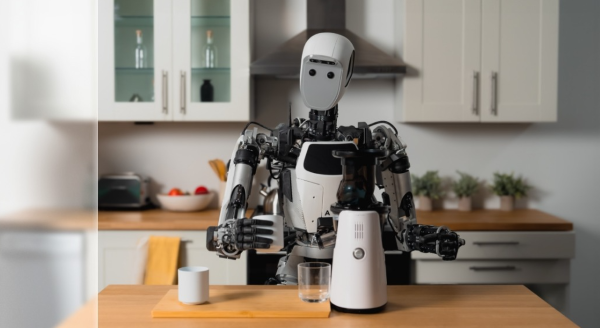
Samsung Electro-Mechanics and LG Innotek have entered a beneficiary phase in the robotics (physical AI) market, following demand for AI servers. Expectations of MLCC (multilayer ceramic capacitor) price increases and expanding parts supply for humanoid robots are converging. Forecasts say both companies could more than double operating profit within 2 years.
Yuanta Securities raised its target price for Samsung Electro-Mechanics to 540,000 won from 370,000 won. iM Securities also lifted its target price to 600,000 won from 350,000 won. Both brokerages expect 2027 operating profit to exceed 2 trillion won. That is more than 30 percent above the current market consensus of 1.6 trillion won.
The driver behind the upgrades is expected MLCC price increases. Yuanta Securities analysed that expectations began forming during the second quarter this year after rival Murata said on its CY4Q25 earnings conference call, "There may be a need to review pricing strategy depending on the market supply-demand environment." Murata said it is operating utilisation at around 90 to 95 percent and is maintaining a policy of keeping it close to 95 percent where possible to build inventory.
With strong demand confirmed for servers and automotive electronics, while the supply-side response remains conservative, there is a sharp rise in the potential for earnings to climb, the outlook said. If MLCC prices rise 10 percent, Samsung Electro-Mechanics' 2027 operating profit would reach 2.2 trillion won, and it would reach 2.8 trillion won if prices rise 20 percent. iM Securities presented a base scenario of Murata implementing an increase in the third quarter, followed by Samsung Electro-Mechanics raising selling prices in the fourth quarter. Given that actual increases were 20 to 30 percent during upcycles in 2000 to 2001 and 2017 to 2018, upside potential remains high.
Robotics is a new epicentre for expanding parts portfolios.
Positive forecasts are also continuing for LG Innotek. DS Investment & Securities and Mirae Asset Securities estimated first-quarter operating profit at 192.2 billion won and 189.3 billion won, respectively, above the consensus of 169.0 billion won.
LG Innotek has begun to post concrete results in the physical AI market. DS Investment & Securities said that following Boston Dynamics, supply of robot camera modules to a North American customer is also imminent. If mass-production volumes rise in earnest in 2027, the average selling price (ASP) is also expected to increase on an improved product mix. A single humanoid robot is fitted with 7 to 8 camera modules.
Mirae Asset Securities analysed that the camera system ASP, currently around $400 per unit (about 570,000 won), is highly likely to enter an upward cycle in the mid to long term as robot performance advances.
LG Innotek CEO Hyuk-soo Moon (문혁수) said after a shareholders' meeting on March 23, "We are in active talks with key customers in the United States and Europe, centred on integrated sensing modules such as LiDAR and cameras." He added, "We expect large-scale mass production of robot parts in 2027 to 2028."
DS Investment & Securities forecast that LG Innotek will expand its supply targets into adjacent parts such as sensors, LiDAR and motors, broadening its role as a solution supplier. iM Securities assessed that Samsung Electro-Mechanics could also gain additional momentum in its module business if applications expand faster into robots and autonomous vehicles.
In particular, the two companies share a common feature: demand drivers are structurally shifting to B2B data centres and robotics, maintaining a long-term industry transition trend. According to iM Securities, the B2B share of Samsung Electro-Mechanics' MLCC revenue from automotive electronics and servers is expected to expand to 41 percent in 2027 from around 20 percent in 2022. A shift from existing B2C-centred demand to B2B can reduce dependence on inventory cycles and strengthen a profit structure based on real demand. As a result, earnings stability is expected to rise compared with the past.
FC-BGA (flip-chip ball grid array) package substrates are also seeing profitability improve steeply as volumes for AI servers expand and utilisation rises. Yuanta Securities said it is a rare phase in which the two core businesses, MLCC and FC-BGA, are improving in the same direction.
LG Innotek's package solution division also posted operating profit of 128.9 billion won last year, up 82 percent from 70.8 billion won a year earlier. Moon said maximum capacity for semiconductor substrates such as RF-SiP is approaching and that the company plans to expand it to about double the current level when it increases capacity.
The key issues are when MLCC price increases materialise and how quickly robot mass-production volumes expand. iM Securities said, "The possibility that the timing of price increases could be pulled forward is also potential upside." But Moon said in robotics, "A meaningful figure could come out 3 to 4 years from now," meaning time is needed before it translates into actual company earnings.
 Dae-geon Seok
d2dg@d-today.co.kr
Dae-geon Seok
d2dg@d-today.co.kr