
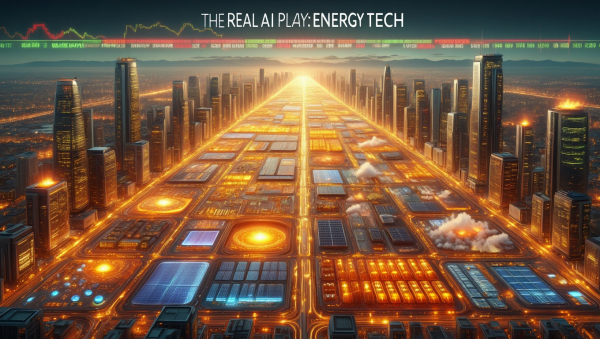
As an investment boom in artificial intelligence (AI) startups continues, data centre power shortages are emerging as a new investment opportunity.
TechCrunch reported on March 20 that venture capital funding for AI has topped $500 billion over the past five years. But as power infrastructure falls short of surging demand, investment priorities are gradually shifting.
A report by Sightline Climate said that of data centre projects it is tracking with a total capacity of 190 gigawatts (GW), only 5 GW are actually under construction. Up to 50 percent of all projects risk delays due to power shortages, and about 36 percent of projects scheduled for 2025 have also been pushed back.
The power crunch could affect the broader AI industry. Data centres are core infrastructure for AI services, and without secured electricity supply, technology expansion itself could be constrained.
As shortages deepen, big tech companies such as Google, Meta, Amazon and Oracle are moving to secure power directly. They are expanding large-scale investment in renewable energy projects such as solar, wind and nuclear power, while pushing to adopt on-site generation near data centres or hybrid models that run alongside the grid.
On-site and hybrid models account for less than 25 percent of projects where power supply has been secured, but they make up 44 percent by total capacity. This shows companies are prioritising stable power supply as their top task.
Investment and interest are also concentrating on long-duration energy storage solutions, such as the 100-hour battery technology of U.S. battery startup Form Energy. Google is pursuing a plan to combine a 30 GWh battery with wind and solar power at its Minnesota data centre.
Goldman Sachs forecast that data centre power consumption will rise by up to 175 percent by 2030 as AI spreads. With shortages in the power grid and ageing facilities overlapping, upward pressure on electricity prices is also growing.
Policy pressure is also continuing in this situation. The U.S. government is stepping up its response by demanding that big tech companies build their own power facilities or bear higher electricity rates.
Beyond power supply, power management inside data centres is also emerging as a new investment area. Most transformer technology is based on designs that are more than 100 years old, limiting its ability to handle the high-density electricity demand of the AI era. As a result, funding is flowing to 'solid-state transformer' startups applying silicon-based power electronics technology.
Amperesand, DG Matrix and Heron Power are developing power conversion technology, while Camus, GridBeyond and Texture are building software to optimise power flows.
The industry is paying attention to power infrastructure investment as an alternative that can hedge risks in the AI industry. The scale is relatively small compared with AI investment, but demand is clear, and stable returns are expected, according to the assessment. A view is spreading in the market that "it may be wiser to invest in the power that runs AI than to invest in AI."
 Jinju Hong
hongjj@d-today.co.kr
Jinju Hong
hongjj@d-today.co.kr