
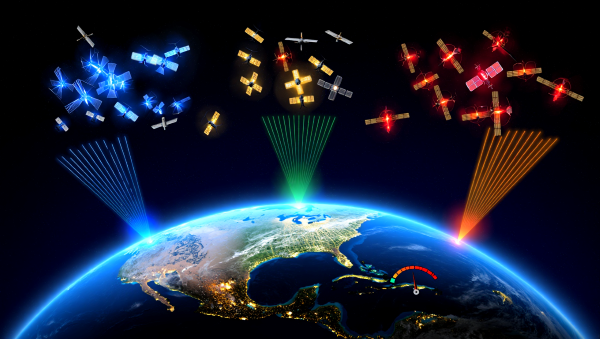
As the low Earth orbit (LEO) satellite industry grows rapidly, global investment and technology competition are intensifying further.
A report by space investment analysis platform Space IQ, cited by business outlet CNBC on March 22 (local time), showed investment in LEO satellites in 2025 exceeded $45 billion. That was nearly double the $25 billion recorded in 2024.
NASA defines LEO as space at altitudes of 2,000 kilometres or lower. The band is quickly emerging as core infrastructure supporting global navigation, communications, defence and worldwide connectivity. LEO satellites close to Earth have fast response times and lower launch costs, and they also have less communications latency. They offer greater operational flexibility than medium Earth orbit (MEO) or geostationary orbit (GEO) satellites, making it common to deploy thousands in clustered constellations to expand global coverage.
LEO is now regarded as a strategic asset, like ports, undersea cables and energy grids. A leading example is SpaceX's Starlink, being built by Elon Musk. More than 9,500 satellites are currently in operation, with plans to deploy several thousand more. It was also reported to be pursuing a solar-powered space data centre concept and projects using as many as 1,000,000 satellites.
Competition is also fierce. Nvidia introduced a new platform that extends artificial intelligence (AI) computing into orbit, and Amazon's LEO venture Project Kuiper has signalled it will launch more than 3,000 satellites. It also received approval from the U.S. Federal Communications Commission (FCC) to deploy an additional 4,500. Blue Origin, founded by Jeff Bezos (제프 베조스), is also being discussed as having a plan to launch more than 5,000 satellites by 2027.
In Europe, Eutelsat's OneWeb LEO network is operating more than 600 satellites. The French government is investing 1.35 billion euros, about 2.4 trillion won, in Eutelsat to support its competitiveness against Starlink. China has also announced plans to deploy more than 200,000 satellites through 14 satellite constellations.
This expansion is changing not only how space is used but also regulation and commercial structures. Since 2009, more than $400 billion has been invested in the space economy. More than half was concentrated in the United States, followed by China. Chad Anderson (채드 앤더슨), chief executive of Space Capital, said the space industry is in the early stages of an infrastructure cycle that will last decades. He expected SpaceX's initial public offering could become the space industry's "Netscape moment".
There is also criticism that institutions and laws are not keeping up with the pace of the industry's expansion. Existing space treaties were designed around geostationary orbit, but LEO assumes a much more complex operating environment. Experts stress that legal frameworks designed for an era of state-led space development will struggle to handle the rapid growth of the LEO industry, and that the regulatory system needs to evolve.
As the LEO industry is reshaped around the private sector, it is emerging as next-generation infrastructure that will reduce the digital divide and as a key battleground that will change global connectivity. Martijn Rogier van Delden (마르틴 로히어 반 델덴), head of Amazon's LEO efforts, said, "LEO satellites will be a game changer connecting billions of people."
 Seung-a Yoo
ysah@d-today.co.kr
Seung-a Yoo
ysah@d-today.co.kr