
[Digital Today reporter Lee Ho-jung] "It feels like a good company, but maybe a somewhat bad stock." A shareholder said this at the meeting.
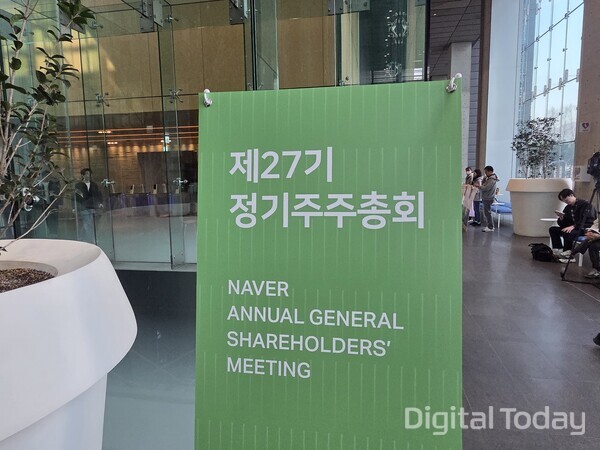
Naver held its 27th annual general meeting of shareholders on March 23 at its Green Factory headquarters in Bundang, Seongnam, Gyeonggi Province. It was a chance to confirm the company's best-ever results, but attention in the room was focused more on the share price than on earnings.
Shareholders approved all five agenda items as proposed: approval of financial statements, partial amendments to the articles of incorporation, appointment of internal director Kim Hee-cheol, reappointment of outside director Kim Yi-bae as an audit committee member, and approval of the cap on directors' compensation. A total of 6,673 shareholders attended, including proxy shareholders.
◆Despite record results, shareholders' questions focus on the share price
In a business report, Naver CEO Choi Soo-yeon (최수연) said 2025 consolidated operating revenue rose 12.1 percent from a year earlier to 12.035 trillion won and operating profit rose 11.6 percent to 2.21 trillion won. Net profit for the period, however, fell 5.9 percent to 1.82 trillion won.
By business segment, commerce posted the highest growth, rising 26.2 percent from a year earlier to 3.69 trillion won. The search platform grew 5.6 percent to 4.17 trillion won, and fintech rose 12.1 percent to 1.69 trillion won. Naver Pay payment volume increased 19.3 percent to 86.1 trillion won.
On shareholder returns, the company announced a new three-year policy for fiscal years 2025 to 2027. It will use 25 to 35 percent of its two-year average consolidated free cash flow for cash dividends or share buybacks and cancellations. The 2025 dividend was set at 393.6 billion won, about 30 percent of consolidated free cash flow, with 2,630 won per share to be paid in April. The treasury share ratio fell to 4.6 percent at end-2025 from 9.0 percent at end-2021.
During deliberations, a formal shareholder proposal called for freezing the cap on directors' compensation and raising the dividend (2,630 won to 3,000 won), saying shareholder returns were weak relative to corporate value. Choi said the dividend had been fixed by a board resolution, but added the company would strengthen its shareholder return policy through share buybacks and cancellations.
After the votes, shareholders continued to voice complaints about the weak share price during additional questions and answers. One shareholder said it had been a good company that had grown steadily for three years and pursued shareholder-friendly policies, but felt like a bad stock from a shareholder's perspective. The shareholder said Naver, which brands itself as an AI company, instead missed the flow of AI beneficiaries in the strong AI-themed market in 2025, and cited concerns including a gap in financial firepower with global big tech and a falling share of search platform revenue.
Choi said management KPIs include no target for the share price, but most of her compensation is linked to the relative share price increase within the KOSPI200. She said she would do her best to raise the stock's relative value. On the claim that Naver was being overlooked in AI, she said the market still evaluates AI with a focus on infrastructure and hardware, but a stage would come when software and service companies that generate real value are re-rated. Choi stressed that Naver differentiates itself with locally specialized AI, including a health agent based on Seoul National University Hospital data and agents directly connected to Smart Store and Place databases.
◆Questions also follow on a Dunamu merger, robots and sovereign AI
With the share price weak, shareholders also persistently pressed on the substance of future growth engines.
Questions continued on a business combination with Dunamu. Issues raised included the status of regulations limiting major shareholder stakes, overlap in business areas and progress on stablecoin legislation. Choi said it was difficult to comment in detail because related bills were still under discussion, and added the company would refine the transaction structure and business once the legislative framework takes shape.
Shareholders also asked about the robotics business. They said there had been too little disclosure of its vision and asked what basis Morgan Stanley used to cite Naver as the country's top company in robotics. Choi said Naver has been conducting proof-of-concept work at 1784 on OS and cloud linkage technology for 100 to 200 robots collaborating, and is pursuing a strategy of resolving hardware through external cooperation while focusing on software and foundation models. She said the company plans this year to run a proof of concept for outdoor delivery robots at a housing complex in Saudi Arabia.
On the sovereign AI revenue model, she said the main model is Neurocloud built together with cloud, structured to generate recurring subscription revenue.
◆New CFO Kim says company to strengthen AI-era investment and decision-making
After the meeting, Kim Hee-cheol (김희철), a newly appointed internal director and chief financial officer, met reporters and pointed to strengthening investment and decision-making to respond to the AI era as the company's next move amid the weak share price. Kim said the AI era requires various discussions across many areas and group companies, and that as CFO he needs important execution and decisions to respond to change.
On global M&A, he said the company is conducting extensive reviews to respond to change rather than making a simplistic point that investment will suddenly increase, and that it could make an active investment decision if deemed necessary. He added that some discussions under way could fall through, while others could become more concrete and be disclosed later. On the Dunamu merger, he said government approval is currently in progress, and while talks on related legal revisions could have some impact, the targeted direction remains unchanged.
On regulations limiting major shareholder stakes in fintech, he said various possibilities such as 20 percent and 34 percent are being discussed, and that once regulations are finalized the company will revise its fintech strategy accordingly. He said nothing has been finalized so it will proceed in line with the existing direction for now.
Kim joined Naver in 2003 and has worked in finance, and after being appointed CFO in April 2025, he took on a registered director role at the shareholders' meeting. It has been about 10 years since a CFO joined Naver's board.
 Lee Ho-jung
lhj@d-today.co.kr
Lee Ho-jung
lhj@d-today.co.kr