
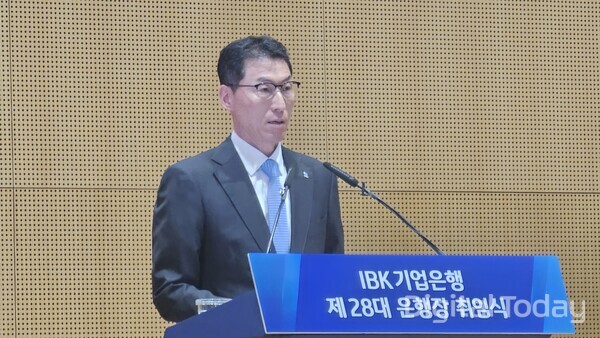
After a labour-management standoff that lasted more than a month, Jang Min-young (장민영) has finally taken office as IBK Industrial Bank of Korea’s chief executive. The vacuum in leadership has been settled for now after a dramatic agreement, but internal issues such as the total wage cap system and allowance settlement remain. Analysts also say the bank faces a difficult task of proving its responsibility as a policy lender amid a low-growth crisis.
According to the bank on Feb. 20, Jang held an inauguration ceremony at its headquarters that day and began official work as its 28th chief executive.
Jang was appointed on Jan. 23 but was unable to enter the headquarters for 22 days because of the union’s campaign to block his commute. The standoff ended after the two sides reached a final agreement on a wage bargaining proposal on Feb. 13, just before the Lunar New Year holiday.
Agreement reached but gap in perceptions remains
The core of the conflict was a compensation system issue, including unpaid compensatory leave and special performance pay. The union launched a hardline campaign, demanding full cash payment for unpaid compensatory leave for all employees and payment of special performance bonuses.
The labour-management agreement includes a declaratory agreement to normalise the issue of unpaid allowances. The union has estimated the size of unpaid allowances at about 150 billion won. The provisional agreement amount is said to be about 83 billion won. It is not final and is expected to be finalised by the management budget review committee after consultations between the bank and the Financial Services Commission.
Some assessments say the agreement is closer to a patch than a solution because the gap in perceptions between labour and management has not been fully resolved.
The two sides also agreed in the document to improve compensation and work structures across the organisation, including an increase in an employee stock ownership programme, expansion of effective compensation, improvements to the management evaluation system and efforts to reduce workloads. The aim is to move beyond short-term conflict while pursuing mid- to long-term discussions on institutional improvements.
In that atmosphere, the union also delivered a public message at the inauguration ceremony. Union chief Ryu Jang-hee (류장희) publicly asked Jang to become a "comrade". Ryu said, "A leader of IBK is a CEO externally, but internally must be someone who protects workers and sometimes fights alongside them," and added, "Please create a fair workplace where people are properly and promptly compensated for as much as they work and struggle."
Ryu also said, "We know the government is our practical employer, but that does not mean the management’s responsibility disappears," and added, "We will continue the struggle to have IBK’s special nature recognised."
Jang responded in kind. He said, "I will listen with an open mind to the union’s sharp criticism as well as its sincere advice," and added, "I will do my best to improve wages and welfare in cooperation with the union."
"300 trillion won by 2030" as productive finance goes into full operation
Jang also made clear his intention to strengthen the bank’s role as a policy lender while managing internal conflict.
In his inaugural address, he said he would put into full operation an IBK-style productive finance project that invests 300 trillion won by 2030. He said the bank would expand funding for future new industries such as AI, semiconductors and energy.
He also plans to expand financial support by stage of company development, from early start-up to growth and maturity, and to overhaul the loan screening system to reflect technological capability and growth potential. The bank also plans to increase investment in capital markets and strengthen group-level fund management.
He said the bank would also expand support for small merchants by pursuing support policies worth 75 trillion won. He said it would lower interest burdens through low-interest refinancing loans and build a comprehensive support system combining debt adjustment and management consulting.
Internal homework and external challenges put trust restoration at the centre
Jang also presented a blueprint to remake IBK into an "AI company". He said the bank would combine its vast corporate finance data with AI to upgrade analysis, screening and soundness management, and implement hyper-personalised tailored services. He also declared that the organisation’s culture would be redesigned to be AI-friendly.
He also stressed strengthening internal controls and consumer protection. He said, "A financial institution can completely lose customers’ trust with just one incident," and pledged to establish trust-based finance. Because the bank experienced a large-scale financial incident last year, overhauling internal controls is seen as an urgent task.
He also mentioned that the bank has a dual character as a policy lender and a listed company. Jang said, "We will continue to grow in a balance between public interest and commercial viability," and added, "We will reduce unnecessary reporting and delegate authority to the field to focus on the essentials."
Ultimately, Jang faces two tasks. One is an internal task of resolving employee compensation issues under the institutional limits of the public sector total wage cap system. The other is an external task of proving the bank’s value as a policy lender amid a macro environment of low growth and industrial transition.
On the internal task, the labour-management agreement has put a period on the immediate dispute, but whether exceptions to the total wage cap apply and whether unpaid allowances are settled will depend on talks going forward.
A financial industry official said, "Within IBK’s special nature of having to find a balance between public interest and commercial viability, attention is on whether the Jang Min-young leadership can solve both tasks at the same time: restoring labour-management trust and demonstrating policy finance leadership."
 Lee Ji-young
ljy@d-today.co.kr
Lee Ji-young
ljy@d-today.co.kr