
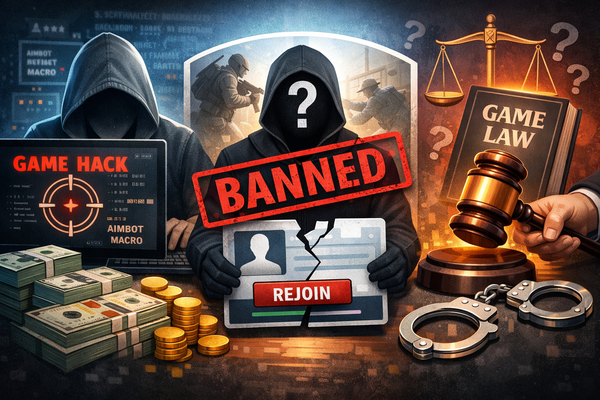
[Digital Today reporter Lee Ho-jung] Major South Korean game companies are mobilising everything from artificial intelligence (AI) detection and criminal complaints to user clean campaigns to eradicate illegal programs, known as "hacks", but are struggling to deliver results. As technical responses become more advanced, illegal programs are also becoming more sophisticated, and gaps in the current legal system are cited as a structural limit.
AI to criminal complaints... Company responses
Krafton operates its own anti-cheat solution, "Zakynthos", in Battlegrounds, and is expanding the scope of sanctions by additionally adopting kernel driver and DMA (Direct Memory Access)-based detection. It has also developed an AI voice recognition detection system to block promotion of illegal programs through voice chat, and has been applying it in stages since the first quarter of this year. As of November last year, it imposed permanent restrictions on about 7.81 million accounts.
NCSoft is a representative case that operates AI detection, real-time in-game sanctions and criminal complaints together. It introduced 3 AI-based detection models in Lineage M. Starting with the AI NPC "Knight of the Mind's Eye" in Throne and Liberty (TL), it also deployed "guard" NPCs in the field in Lineage Classic to track and remove hack users in real time.
Lineage Classic was a hit, recording cumulative sales of 40 billion won and a peak concurrent user count of 320,000 just 15 days after launch, but macro issues quickly surfaced. NCSoft has continuously taken various measures against abnormal play accounts since launch, including sanctions, verification steps and moving players to jail. As of the 19th, measures had been taken on about 3.62 million accounts.
In Aion2, it also pursued legal action. It filed criminal complaints against about 10 illegal macro users on charges of obstruction of business. Account sanctions have also continued, and as of the 19th, usage restrictions had been applied to a cumulative 1,372,512 accounts through the 125th round of sanctions.
Nexon is operating a solution called LBD (Live Bot Detector) to detect abusing patterns through cooperation between its game hack response team and its AI organisation, Intelligence Labs. Netmarble has adopted an approach that uses deep learning on game logs to detect abnormal behaviour patterns themselves, rather than simple memory tampering, and is applying it to Vampir, RF Online Next and Raven2. It also plans to include it in SOL: Enchant, scheduled for release on April 24. Kakao Games has also recently introduced new AI technology to detect patterns of illegal use.
Companies are responding differently because illegal behaviour varies by genre. Krafton, which focuses on FPS games, has expanded detection to the hardware level and even voice channels, while Netmarble, which has a high share of MMORPGs, is focusing on abnormal behaviour pattern detection. That can be seen as reflecting each company's service environment.
Campaigns and even vigilantes emerge... but the law blocks action
Game companies are also running clean campaigns. Nexon provides Nexon Cash worth 10,000 to 100,000 won to MapleStory users who participate in reporting, and NCSoft is running a clean campaign in Lineage Classic until the 25th of this month. Publicly disclosing the number of sanctions is in the same vein. The strategic purpose is to deliver a warning to those attempting unfair play while also instilling an awareness among existing users that the company is working to improve the environment.
However, a "vigilante" phenomenon is also emerging as users who feel the limits of official responses take matters into their own hands. In Lineage Classic, video content in which users said they would find their own way because NCSoft could not catch macros drew attention by recording hundreds of thousands of views. Lineage Classic has a "chaotic" system in which a character's name turns red if it attacks other players above a certain level, making it difficult for normal users to directly attack farming operations. Users instead devised ways to indirectly eliminate macro characters by sending pets forward, or to block only farming operations by sealing off choke points on hunting routes.
Because it is a hardcore game centred on manual hunting, when farming operations occupy hunting grounds with automated programs, ordinary users struggle to secure a spot, and item values also fall due to the large volume of goods pouring in. The more diligently users play, the greater the sense of deprivation. The phenomenon is a clear example showing that the official sanctions system is not sufficiently resolving on-the-ground inconvenience.
A shared limitation of technical and campaign responses is a structure that allows users to rejoin after an account suspension. A fundamental problem is that there is no legal deterrent to block this. Current law regulates mainly the production and distribution of illegal programs, and does not provide separate grounds to punish users. Some game companies filing complaints against users on charges of obstruction of business under the Criminal Act is a way of bypassing this gap in the Game Industry Promotion Act. Critics also say the level of punishment is limited to up to 1 year in prison or a fine of up to 10 million won, which is too low to deter illegal distributors who earn tens of millions to hundreds of millions of won.
A revision bill sponsored in 2024 by Jun Yong-gi (전용기), a lawmaker of the Democratic Party, included creating a user sanctions provision and raising the penalty for making and distributing illegal programs from the current "up to 1 year in prison or a fine of up to 10 million won" to "up to 5 years in prison or a fine of up to 50 million won". In the same year, during a parliamentary audit, Democratic Party lawmaker Yang Moon-seok (양문석) pointed out, "We have only caught illegal program developers and distributors, but now it is time to regulate users too." Yang also sponsored a partial revision to the Game Industry Promotion Act in May 2025 containing grounds to punish users, but it was withdrawn after controversy emerged over the scope of application.
Currently, a full revision bill of the Game Industry Promotion Act sponsored by Democratic Party lawmaker Cho Seung-rae (조승래) has entered the National Assembly discussion stage. The revision includes a provision that brings into the scope of punishment acts that habitually use illegal programs and cause serious disruption to other users' game use. However, there is also a counterargument that directly imposing criminal punishment on users is excessive legislation, and substantial debate remains before passage. Critics also say most illegal farming operations are overseas organisations using VPNs and stolen personal information, limiting the effectiveness of domestic legislation alone.
An industry official emphasised that effective deterrence is possible only when clear grounds to punish usage behaviour are 마련돼야, adding that "in a reality where detecting and suspending accounts means little if they can simply rejoin, legal costs must be high enough for a fundamental deterrent to emerge."
 Lee Ho-jung
lhj@d-today.co.kr
Lee Ho-jung
lhj@d-today.co.kr