
With bitcoin (BTC) volatility rising, an artificial intelligence (AI)-based trading strategy that aims to spot the point when real buying demand flows in, rather than trying to call the bottom, is drawing attention. BeInCrypto, a blockchain outlet, reported the details on March 19 (local time).
Geoff Kendrick, head of digital assets research at Standard Chartered, assessed that bitcoin could become more attractive to buy below $60,000. He also said the possibility of a further decline to $50,000 should be left open. In other words, the current market is an “uncertain zone” where upside potential and downside risk coexist.
In such a market without a clear direction, some point out that strategies to predict the exact bottom can be risky. As a result, some traders are choosing to enter a “confirmed zone” where the market structure has recovered, rather than trying to pick the lowest price.
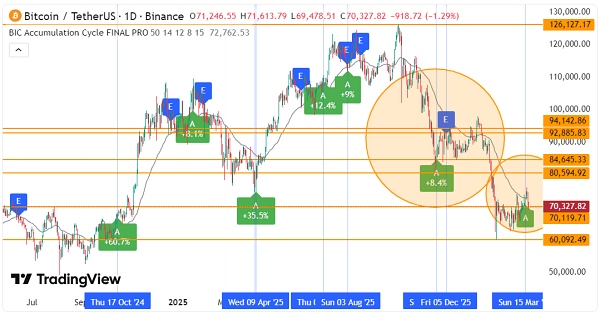
A representative example is the “Accumulation Cycle” model developed by BeInCrypto. The model does not estimate a bottom. It generates an accumulation signal only when three conditions are met: the price regains key levels, upward momentum forms and the price stabilises without further declines. This is a conservative approach that enters only after a decline has stopped and a reversal is confirmed.
This feature is also evident in real cases. In February 2026, when bitcoin fell to $60,000, no signal was generated. That was because the market was still in a bearish trend. In mid-March, after bitcoin regained $70,000, the first accumulation signal appeared, and it was interpreted as an early sign of a bullish turn.
A similar pattern repeated in November 2025. Bitcoin fell to about $80,500 but the model did not react. A signal was generated only after it recovered to around $84,600. The price later rose to about $92,800, capturing a roughly 8 percent profit range in that cycle.
The model aims not at the exact bottom but at a stable rising range. Most signals focus on capturing relatively steady gains in an 8 to 12 percent range, and analysis suggests it also identified rising cycles of about 30 to 60 percent in some periods.
This approach also partly aligns with on-chain data. Looking at indicators tracking net position changes among long-term holders, accumulation signals often overlapped with points when selling pressure peaked and then eased. That means the signal is linked not only to simple price moves but also to actual fund flows.
A similar pattern is being observed in the current cycle. Since the accumulation signal in mid-March, net buying by long-term holders has continued, and no end signal has appeared yet. This suggests the rising cycle may not have fully ended.
Experts stress that bitcoin is not an asset that rises in a straight line, but has a “cycle structure” that repeats advances and corrections. Accordingly, AI-based trading models could be used as tools to target higher-probability zones in volatility, rather than trying to nail extreme timing.
This strategy is closer to confirming and responding than to predicting the market. In an uncertain market, the trend of investors making decisions based on structural signals rather than intuition is strengthening.
 Jinju Hong
hongjj@d-today.co.kr
Jinju Hong
hongjj@d-today.co.kr