
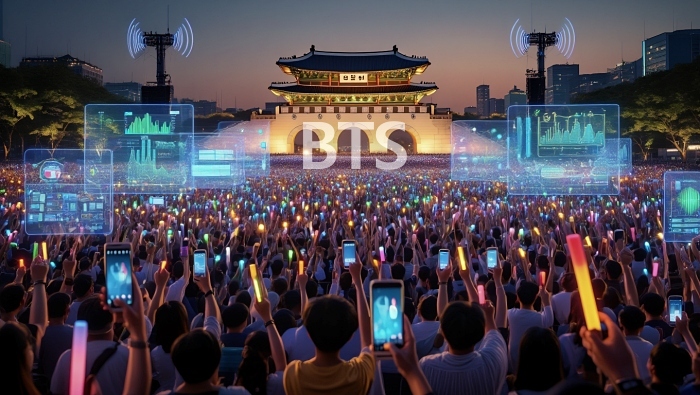
A BTS concert to be held on March 21 in Seoul's Gwanghwamun will be broadcast live worldwide on Netflix. The live stream, targeting more than 300 million subscribers, is also a global hot issue from a technology standpoint. The concert is drawing particular attention because it is a case in which content originating in South Korea is delivered worldwide in real time over global cloud infrastructure.
Live streaming relies on technologies that differ significantly from video-on-demand (VOD). For VOD, content can be uploaded in advance to servers around the world. Live is different. As the show unfolds, video signals must be collected and encoded and simultaneously sent to hundreds of millions of devices. Traffic surges at the start of an event, and a single technical failure immediately affects the viewing experience of hundreds of millions of people.
With this in mind, Netflix has built and advanced its own live streaming infrastructure based on AWS cloud. Starting with its first live comedy special in 2023, it has run hundreds of live events, from NFL games to WWE and boxing matches.
The BTS Gwanghwamun concert is unprecedented in scale, further heightening interest in large-scale live streaming. In live streaming, video signals are sent to the AWS cloud via a broadcast operations centre.
The key is redundancy. Two AWS regions simultaneously receive signals through 2 independent network paths each. The structure keeps 4 independent streams running at all times. It is also based on the SMPTE 2022-7 protocol, an industry standard, switching to another path before viewers notice even if one path fails.
Once the signal reaches the cloud, real-time encoding begins, instantly converting captured video into formats suited to various devices and internet speeds. Using AWS Elemental MediaLive, the original video is converted into multiple quality levels from SD to UHD and into 2 formats, AVC and HEVC. In this process, the most suitable quality is automatically selected based on viewers' internet speeds and device performance. Multilingual audio and subtitles are processed simultaneously to support viewers worldwide.
The converted video is delivered via Netflix's own CDN, Open Connect. It delivers video from locations close to viewers through more than 18,000 servers deployed at more than about 6,000 sites worldwide. That reduces physical distance to minimise latency.
During the BTS live broadcast, the system will process up to 38 million system events per second in real time. It will proceed by combining advance capacity 확보 and automatic scaling to prepare for traffic spikes at the start of the event.
AWS and Netflix also have a system to respond pre-emptively, using real-time viewership predictions before more viewers are affected.
The performance is also a major issue in terms of how people experience content. Through live streaming, content shifts from something that can always be watched to something that global fans experience together at the same time. Regardless of venue capacity, more than 300 million Netflix subscribers can access the same performance across locations and time zones. AWS explained that cloud-based infrastructure is lowering technical barriers to global simultaneous live broadcasts, opening a path for South Korean content creators, including K-pop, to meet viewers worldwide in real time.
Key AWS technologies supporting the performance are AWS Elemental MediaConnect, AWS Elemental MediaLive, the cloud storage service Amazon S3 (Amazon Simple Storage Service), and AWS cloud infrastructure (AWS regions).
AWS Elemental MediaConnect is a transport service for live video, delivering live video signals in high quality from broadcast sites to the cloud environment.
Netflix uses the service to collect and process live feeds from broadcast facilities to the cloud and to manage redundancy and failover.
AWS Elemental Live is a cloud-based, broadcast-grade live video encoding service. It converts live video in real time into different resolutions and bitrates, enabling playback on various devices such as TVs, smartphones and tablets.
Amazon S3 is an object storage service and a cloud storage infrastructure that can reliably store and distribute large media files. Netflix used S3 buckets early in live streaming as a 'live origin' that served as the starting point for live broadcasts, but later switched to its own media-aware live origin service because latency and performance service level agreements were insufficient for real-time writing and reading of 2-second segments.
AWS cloud infrastructure deploys live services across multiple AWS regions, independent data centre clusters distributed worldwide. Through a dual-region architecture, which runs the same pipeline in parallel in 2 geographically separated regions, it removes a single point of failure and supports dynamic scaling of computing resources to handle surging traffic at the start of live events, AWS said.
 Chi-gyu Hwang
delight@d-today.co.kr
Chi-gyu Hwang
delight@d-today.co.kr