
Qualcomm declared a new era in which artificial intelligence replaces a device's user interface itself. With platform technology built up over 20 years and a joint design partnership with Samsung Electronics as twin pillars, it plans to expand an on-device AI ecosystem from smartphones into the PC market.
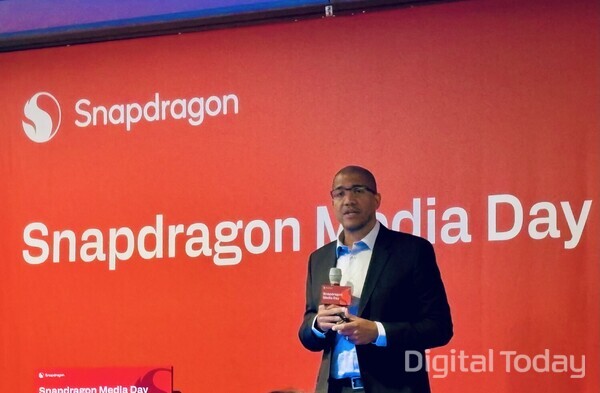
Kedar Kondap, vice president of product management at Qualcomm, said at the Snapdragon Media Day event in Seoul on Thursday that "AI is the new UI". He said the way users interact with devices will fundamentally change around AI across smartphones, PCs, XR glasses and wearables.
Qualcomm laid out three core requirements for on-device AI: fast response, privacy protection and power efficiency. It touted its Hexagon NPU as the engine to deliver them. Qualcomm said it has shipped more than 20 billion AI cores worldwide to date. Kondap explained that running the same AI workload on an NPU can improve power efficiency by about 3.8 times compared with a GPU.
Qualcomm said its on-device AI strategy comes from system integration optimisation rather than chip performance alone. It described a three-layer structure: Hexagon NPU inside the SoC; collaboration with Microsoft at the operating system level to optimise the Copilot+ experience; and support for major frameworks such as PyTorch, ONNX and TensorFlow at the app level to build a developer ecosystem. The number of AI-optimised apps using the NPU has risen to more than 100.
The company said a joint design partnership with Samsung Electronics underpins the strategy's execution. Chris Patrick (크리스 패트릭), a Qualcomm senior vice president and head of the mobile handset business, said designing a chip and mailing it is impossible given the complexity of modern smartphones. He said Qualcomm co-designs the platform with Samsung over several years for each generation.
The scope of the cooperation spans tuning CPU, GPU and NPU performance, display-linked customisation and joint innovation in the camera pipeline. The partnership, which began with the world's first CDMA camera phone in 2010, led to outcomes including dual-pixel cameras, 100x zoom and on-device AI real-time interpretation. It will be implemented with "for Galaxy" branding in the 2026 Galaxy S26 Ultra.
Qualcomm Snapdragon expands Korean partnerships in PC market
Qualcomm is extending this mobile cooperation model into the PC market. The Snapdragon X2 series achieved gains versus the previous model of 39 percent in single-thread performance, 50 percent in multi-thread performance, 2.3 times in graphics processing and 78 percent in NPU compute performance, rising from 45 TOPS to 80 TOPS.
Kondap said 150 PC designs have been launched in the market in the 18 months since the X series debuted. Native apps have tripled from a year earlier, and supported games have increased to more than 1,800. Epic Games' anti-cheat software also supports Snapdragon.
Qualcomm is also stepping up its push into the South Korean market. On the day, Qualcomm unveiled major Korean distribution and IT partners including Coupang, Naver, Lotte Hi-Mart, Daewon CTS and Gmarket. Don McGuire (돈 맥과이어), Qualcomm chief marketing officer, said Snapdragon brand awareness in South Korea is 68 percent, ranking third globally after India at 78 percent and China at 87 percent. He said 61 percent of South Korean consumers perceive Snapdragon as improving the quality of premium Android phones, and premium preference is 6 times that of competing brands.
Qualcomm's message is that competitiveness in the AI era comes not from single-chip performance but from a combination of an NPU-centric SoC, the OS and app ecosystem, and partnerships that co-design down to the device level, such as with Samsung Electronics. It said the more the shift accelerates in which on-device AI replaces the UI, the more this "full-stack optimisation" capability will determine market dominance.
 Seok Dae-geon
d2dg@d-today.co.kr
Seok Dae-geon
d2dg@d-today.co.kr