
[DigitalToday reporter Chi-gyu Hwang (황치규)] Signals are emerging that companies selling AI applications are finding it harder to do sales than before, drawing attention.
A recent Wall Street Journal report said that as companies shift into a cautious mode, AI software companies are saying it is taking longer than last year to reach purchase decisions.
Last year, board-level directives, fear of missing out (FOMO) and aggressive campaigns by tech companies combined to drive companies to invest actively in AI. Market research firm Gartner estimates that 1.249 trillion dollars was spent on software alone last year.
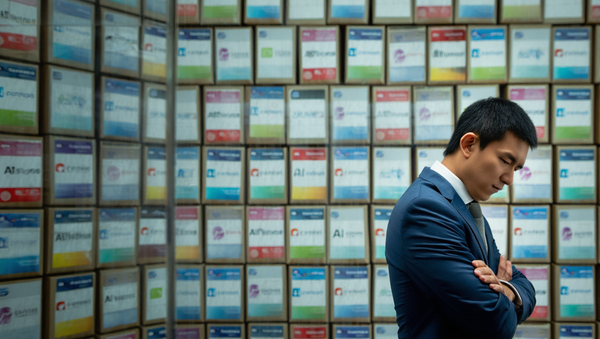
These days, companies appear to be more cautious about buying AI software than last year. The WSJ cited AI-based customer service startup Regal as an example, reporting that while deals could be closed in 60 to 90 days last year, it now typically takes 180 days to complete a purchase.
Alex Levin (알렉스 레빈), Regal's CEO, said, "There was a period when early adopting companies quickly embraced innovative technology, but recently that pace has slowed noticeably." Craig Roth (크레이그 로스), a Gartner vice president, also said, "Everyone has become more cautious. I think they are starting to recognize reality."
An analysis says that companies have turned cautious partly because they judge that adopting quickly is not necessarily better. The WSJ reported that early adopter companies that rushed AI pilots and full rollouts last year often hit a wall and learned costly lessons in the process.
Results from a survey by the National Bureau of Economic Research (NBER) of 6,000 executives, including CEOs and CFOs at companies in the United States, Britain, Germany and Australia, also showed that productivity gains from adopting AI remain not large.
Fortune reported that while two-thirds of respondents in the survey said they use AI, actual usage time was only 1.5 hours per week. Twenty-five percent of respondents said they do not use AI at all at work. It also said 90 percent of respondent companies answered that AI has not affected hiring or productivity over the past three years.
Companies' expectations for AI's impact on businesses and the economy remain high. In the NBER survey, executives projected that over the next three years AI would improve productivity by 1.4 percent and increase output by 0.8 percent. There is also a view that AI-driven productivity could follow a 'J-curve' in which it shows an initial slowdown before rising sharply.
But a gap remains between expectations and reality. Fortune said that ManpowerGroup's '2026 Global Talent Barometer,' based on a survey of about 14,000 people in 19 countries, found that while regular AI usage rose 13 percent in 2025, trust in the technology's usefulness fell 18 percent.
Roth said this was not because the technology itself failed to work, but because appropriate safeguards were not in place or because companies did not fully understand the reality of the business processes they were trying to automate. He added, "What is especially important is that they realized it is difficult to measure financial performance. Even the performance they were able to measure was not particularly impressive."
Gartner forecasts that companies' software spending will rise 14.7 percent from a year earlier this year to about 1.434 trillion dollars. But buying styles appear to be becoming more demanding. Roth was quoted as saying that as companies become mature enough to understand potential obstacles, evaluation periods are getting longer and they are taking a more critical approach to the solutions they seek to adopt.
 Chi-gyu Hwang
delight@d-today.co.kr
Chi-gyu Hwang
delight@d-today.co.kr