
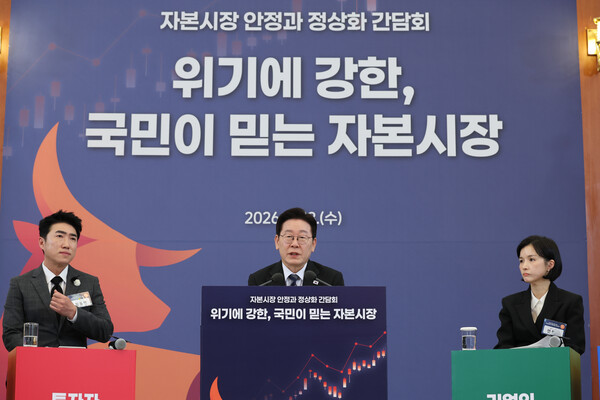
President Lee Jae-myung (이재명) on Tuesday unveiled a high-intensity reform plan targeting the chronic undervaluation of domestic stocks known as the "Korea discount" at a meeting on capital market stability and normalisation he chaired at Cheong Wa Dae.
About 40 experts attended the meeting, including financial authorities, the Korea Exchange, listed companies, individual investors and heads of research centres at domestic and foreign securities firms. They held in-depth discussions on entrenched problems that undermine market fairness, such as strict punishment for stock manipulation, improving rules on treasury shares and issues related to duplicate listings.
Lee vowed "ruin-level punishment" for stock manipulators that erode market trust. He set out a policy to confiscate even the cash used in manipulation beyond simple criminal punishment and to fully claw back illicit gains.
He also decided to significantly strengthen monitoring by paying informants up to 30 percent in rewards and using a leniency programme that reduces penalties if an internal participant provides decisive evidence.
The meeting heard criticism and suggestions on how domestic listed companies use treasury shares. Experts pointed to low capital efficiency in the Korean stock market and said cancellation was essential for treasury share purchases to lead to meaningful shareholder returns rather than simple holding.
Kim Hak-kyun (김학균), head of Shin Young Securities' research centre, cited the practice of companies buying treasury shares and then using them for management control defence rather than cancelling them. He stressed the need for mandatory rules or strong incentives to boost shareholder value.
Kim Dong-won (김동원), head of KB Securities' research centre, also stressed that cancelling treasury shares is a key means of raising return on equity (ROE). He proposed adopting capital management policies in line with global standards.
Participants agreed that tax benefits are currently largely focused on dividends and that bold incentives should also be offered for acquiring and cancelling treasury shares.
They singled out as a key task the need to grant strong benefits such as corporate tax cuts when companies cancel not only newly purchased treasury shares but also treasury shares already held, to encourage firms to actively work to lift share value.
Lee also criticised in strong terms the problem of duplicate listings known as "split listings".
He said, "You clearly bought a nugget-like stock, but one day you see only the core business unit spin out and list, leaving the existing stock as just a shell." He said this was a clear erosion of shareholder value and a problem derived from a chaebol structure unique to South Korea.
Hwang Seung-taek (황승택), head of Hana Securities' research centre, said indiscriminate in-kind splits and relistings lower a parent company's value and betray investors' trust. He suggested that listing reviews should more strictly assess shareholder protection measures.
The government plans to closely examine cases of improper duplicate listings and to strengthen disclosure requirements and improve legal and institutional measures to protect the rights of minority shareholders.
Lee Hyo-seop (이효섭), a research fellow at the Korea Capital Market Institute, called for upgrading monitoring systems to eradicate artificial suppression of share prices and unfair trading practices. He said long-term inflows of foreign investors would become possible only when transparent information disclosure and fair price formation are in place.
Lee also raised the stock settlement period, saying, "Park Yong-jin (박용진), vice chair of the Regulatory Reform Committee, sent me a message asking, 'Why do you sell shares today but get the money the day after tomorrow?'" He added, "If necessary, why not review it as one of the agenda items, including making adjustments."
In the domestic stock market, it currently takes an additional 2 days from trade execution to settlement. Even if an investor sells shares, they do not receive the money immediately and it is paid after 2 business days, on the third trading day. Conversely, when buying shares, margin is paid first and it is possible to make unsettled trades in which shares are acquired if payment is made up to 2 business days later.
Jung Eun-bo (정은보), chairman of the Korea Exchange, said, "We will prepare so that clearing and settlement can take place not late at all, but rather proactively, by keeping a close eye on international trends."
He added, "If trades take place using blockchain technology, the clearing and settlement process will disappear, and I think it will transform into something like immediate payment."
 Oh Sang-yup
yub@d-today.co.kr
Oh Sang-yup
yub@d-today.co.kr