
The government is moving to build an AI service ecosystem with global competitiveness, beyond developing homegrown AI foundation models.
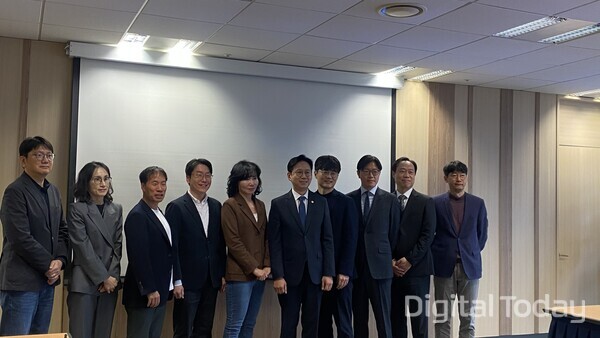
On March 18, Deputy Prime Minister and Minister of Science and ICT Park Kyung-hoon (배경훈) chaired a meeting with companies related to “independent AI” at the main conference room of the Science and Technology Advisory Council in Seoul’s Jongno district. The gathering brought together LG AI Research, Upstage, SK Telecom and Motif Technologies, four participants in the independent AI foundation model project, as well as Naver, Kakao and NC AI.
In opening remarks, Park said, “Why can’t South Korea create a company like Claude or Anthropic? Why can’t we create a company like DeepMind? I think we should try to make one.” The comments came in the context of calling for a shift from a model-development focus to a market and ecosystem focus.
He also said, “As we announce K-Moonshot, we are now setting field-by-field strategies to create an AI co-scientist at a DeepMind level.” K-Moonshot is a national AI grand-challenge project being promoted by the science ministry. The government is setting a plan to have global-level competitiveness in multimodal technology by September this year.
Park also stressed a golden time window. “Success or failure will be decided by how we invest within 2 to 3 years,” he said. “We must not miss this timing.” He added that from a national security perspective, “in connection with the recent situation in the Middle East and so on, the need to secure independent AI for autonomous control and balance as a national strategic asset is being emphasized even more.”
The meeting was run as a session to hear opinions rather than decide a direction. Speaking to reporters afterward, Park said, “Each company has areas it can do well,” adding, “LG AI Research has a science platform such as new drug development, and SKT has its own role, such as applying a lightweight 500B model to the A.Dot service.”
Building an AI service ecosystem was cited as a key task. Park said there was discussion about “creating an overall AI protocol by application area and setting the stage for where to concentrate investment.” He explained that the talks covered direction and global strategy, including whether to aim for conversational AI services or take a general-purpose approach.
On the government’s investment approach, he said, “We will proceed together with large companies through project-based programs, and for startups we will use an equity participation method through the National Growth Fund,” adding, “It is not up to the point of establishing a private joint venture.” The National Growth Fund is a large-scale investment source for AI and semiconductors that was also mentioned at an AI semiconductor company meeting held the previous day. Park had also held a meeting the previous day with domestic NPU companies such as Rebellions and FuriosaAI to discuss investment measures.
On the service ecosystem, he said companies commonly requested that AI service startups be invigorated and real revenue created starting with the launch in April of “Startup for Everyone,” led by the Ministry of SMEs and Startups. Park said, “A boom-up needs to be created this year and next year,” and said he would form a consultative body and communicate closely with companies.
Companies attending the meeting agreed with the government’s goals but called for practical support to expand services. Upstage CEO Kim Sung-hoon (김성훈) said, “A level like (Anthropic and DeepMind) comes out quickly. We can soon catch up with Mistral,” adding, “It must not end with building it, and we need a tokenomics system where the government supports it according to token usage, viewing AI as infrastructure like electricity.”
Park said, “Just as Naver and Kakao grew with competitiveness comparable to global companies during the shift to the internet economy in the past, please join forces so that in the AI era, our companies can be born that will compete confidently on the world stage.”
 Son Seul-gi
sageson@d-today.co.kr
Son Seul-gi
sageson@d-today.co.kr