
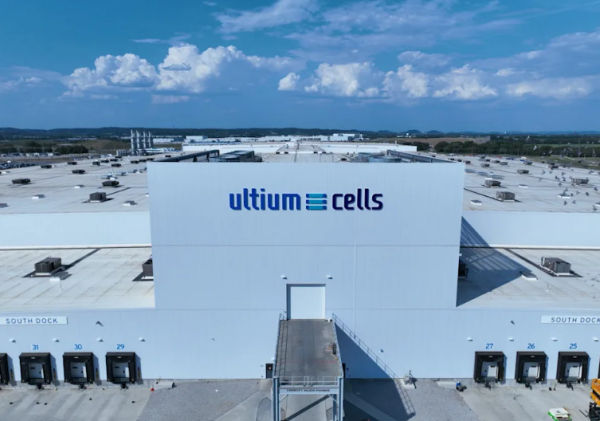
LG Energy Solution has expanded its North American energy storage system (ESS) production base to 5 sites. Ultium Cells, a joint venture between LG Energy Solution and GM, said on Tuesday it will start producing lithium iron phosphate (LFP) battery cells for ESS at its plant in Spring Hill, Tennessee.
The company will convert part of its existing electric vehicle (EV) battery production line for ESS through facility conversion investment and begin full-scale mass production from the second quarter. Some 700 employees who went on temporary leave in January are also expected to return to build the production line.
ESS battery cells produced at the Tennessee plant will be supplied through Vertech, LG Energy Solution's North American ESS system integration (SI) unit. Major demand sources include North American power grid stabilisation projects, renewable energy-linked ESS facilities and power infrastructure for AI data centres.
Ultium Cells CEO Park In-jae (박인재) said the announcement is the Tennessee plant's first large-scale conversion case and shows Ultium Cells is evolving into a diversified battery cell manufacturer. He said the company will advance its production system in line with changes in market demand and strengthen its position as a core and technology leader in the U.S. battery industry.
With the conversion, LG Energy Solution has secured a total of 5 ESS production networks in North America. The bases are its Holland and Lansing plants in Michigan, Canada's NextStar Energy, Ultium Cells' Tennessee plant and the L-H Battery Company, a Honda joint venture in Ohio. The Holland plant began large-scale ESS battery mass production in June last year, the first in North America, and confirmed supply agreements with Terra-Gen and Delta. NextStar Energy in Canada surpassed production of 1,000,000 cells in its first three months of operation and held a completion ceremony earlier this month.
The Lansing plant in Michigan will begin ESS mass production in the first half of this year. It plans to start with pouch-type products this year and produce prismatic LFP batteries from next year, and has already signed a supply contract with Tesla worth about 6 trillion won. The L-H Battery Company in Ohio also plans to convert part of its EV production line for ESS, and LG Energy Solution and Honda are discussing the scale and timing of the conversion.
LG Energy Solution plans to more than double its ESS production capacity by the end of this year to secure more than 60 GWh globally and more than 50 GWh in North America. As of the end of last year, its cumulative global order backlog was about 140 GWh, and its target for new orders this year was set at a level above last year's peak of 90 GWh.
With North American ESS demand rising rapidly due to the expansion of renewable energy and growing power demand from AI data centres, LG Energy Solution is expanding its order backlog by signing a series of supply agreements with global clients such as Tesla, Terra-Gen, Excelsior Energy Capital, EG4 and Hanwha Qcells.
An LG Energy Solution official said the company will use the establishment of its North American five-base integrated manufacturing hub system as a springboard to accelerate overall growth in its North American business, while also strengthening productivity innovation and profitability improvements. The official said it will cement a firm leading position in the North American market, particularly in the ESS business, as it has proactively secured overwhelming production capabilities.
 Suk Dae-geon
d2dg@d-today.co.kr
Suk Dae-geon
d2dg@d-today.co.kr