
The fallout from the U.S.-Iran war is turning Middle East energy supply risks into reality, increasing uncertainty over securing power for land-based data centres. As concerns spread that supply itself could be cut off, rather than just prices rising, orbital data centres (ODCs) that have their own power sources without relying on power grids are drawing attention as a new alternative AI infrastructure.
The limits of land-based data centres are already showing up in the numbers. The International Energy Agency (IEA) projects global data centre power consumption will reach 945 TWh in 2030, more than double 2024 levels of 415 TWh. Data centres' share of power consumption in the United States is also estimated to jump from 3.5 percent now to more than 9.0 percent in 2030. Power infrastructure costs, site acquisition, cooling water and carbon emissions regulation are combining to create overlapping obstacles to expanding land-based data centres.
Barriers to entering space infrastructure are easing, by contrast. Eugene Investment & Securities estimates the cost of building a space data centre is about $166.6 million per 1 MW, about 3.1 times higher than on the ground at $53.88 million. But rocket launch costs that were about $8,000 to $20,000 per kg in the 2010s have now fallen to around $1,000. If SpaceX's Starship, currently under development, is commercialised, costs are expected to drop again to about one-tenth of that level. That is why some are saying the intersection of two curves is coming into view, with costs rising on the ground and falling in space.
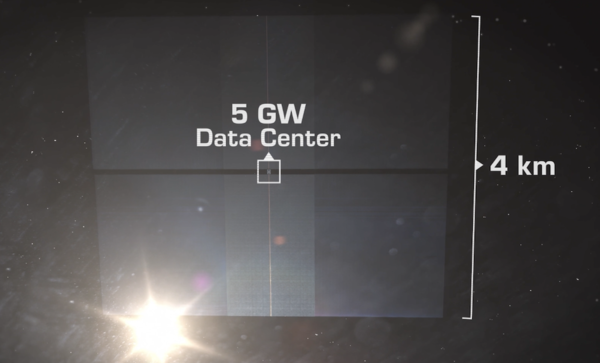
Moves by big tech and AI chip companies underscore that trend. Nvidia unveiled its 'space computing' platform at GTC 2026 and laid out a blueprint to expand AI infrastructure into space orbit. Jensen Huang (젠슨 황), Nvidia's CEO, said, "The era of space computing, humanity's final frontier, has arrived." Nvidia is also pushing ahead with a plan to build a 5 GW-class orbital data centre with startup Starcloud. Google is moving to build a satellite constellation server equipped with its own AI chip, TPU, by 2027, and Amazon founder Jeff Bezos mentioned that GW-class AI data centres will be built in space within the next 10 years.
Jensen Huang, Nvidia CEO, declares at GTC that the era of space computing has arrived
Power and cooling are the key to making space data centres a reality. With no possible connection to a power grid in space, solar power is the only power source. Because launch costs are directly tied to weight and area, solar cells that are simultaneously high-efficiency, lightweight and radiation-resistant are essential. Eugene Investment & Securities analysed that existing silicon solar cells are nearing their single-junction efficiency limit of about 24.5 percent. A leading next-generation alternative is silicon-perovskite tandem solar cells. They have a theoretical efficiency limit of 44 percent, about 50 percent higher than existing silicon at 29 percent, and can be made lighter with a thin-film structure.
Commercial viability is also coming into view. Hanwha Qcells obtained certification for 28.6 percent power generation efficiency from Germany's Fraunhofer Institute in December 2024 using an M10-standard tandem cell. If tandem cells are commercialised, power generation is expected to rise about 15 percent versus current silicon modules with about 23 to 24 percent efficiency. On cooling, radiation is the only cooling method in space because there is no medium. High-emissivity materials and building large radiators are cited as essential conditions.
Demand in the same direction is also forming on the ground. An analysis says that, as an emergency policy to prepare for a deepening energy crisis, battery energy storage systems (BESS) and long-duration energy storage of more than 10 GWh must be installed within a year. The current government is accelerating its energy transition policy on the back of establishing a Ministry of Climate, Energy and Environment, and some project big benefits for related industries. Market analysis says that while the government at the time was passive on energy transition during the Russia-Ukraine war, this time is different. Eugene Investment & Securities stressed that investors should focus on the speed of policy shifts rather than short-term oil price moves.
 Seok Dae-gun
d2dg@d-today.co.kr
Seok Dae-gun
d2dg@d-today.co.kr