
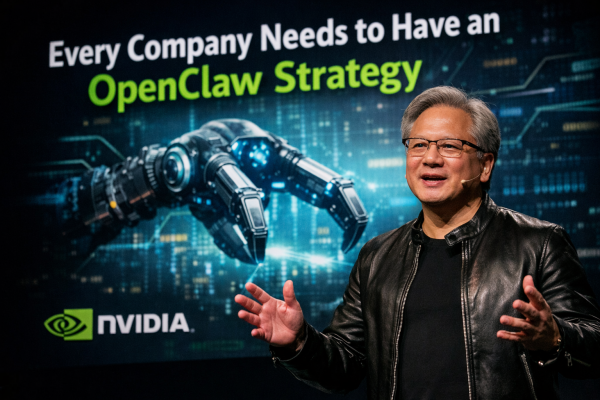
Jensen Huang (젠슨 황), Nvidia's chief executive, urged companies to adopt AI agent strategies, declaring a shift to a new computing paradigm.
On March 16 local time, major foreign media outlets including Business Insider reported that Huang said in a keynote at GTC 2026 in San Jose, California: "Every company should have an OpenClaw strategy and an agentic system strategy." He added, "This is the new computer."
Huang praised OpenClaw, an open-source AI agent project, and named it a core element of next-generation computing. He said OpenClaw would reshape the AI agent market in the way the Windows operating system opened the era of personal computing. "Thanks to OpenClaw, anyone can build a personal AI agent," he said. "It is a technology that delivers exactly what industry needs." Comparing it with Linux, Kubernetes and HTML, he said it had built an open-source stack the broader industry can use.
OpenClaw is expanding into a developer-focused open-source project. Even after OpenAI recruited core developer Peter Steinberger, the project itself remains independent and is widening its ecosystem.
OpenClaw use brings security issues. Nvidia also unveiled NemoClaw, which 강화한 security features. NemoClaw is designed to let AI agents run safely in corporate environments through network safeguards and privacy routing features. "It will make it possible to run Claw safely inside enterprises as well," Huang said.
During the event, Nvidia also ran a "Build a Claw" program to support participants in developing customised AI agents themselves. This is seen as a strategy aimed at both popularising AI agents and expanding the developer ecosystem at the same time.
Huang also presented a strong growth outlook for AI infrastructure demand. He projected that demand for next-generation AI chips based on Blackwell and the Rubin architecture would reach $1 trillion by 2027.
Nvidia has already built a dominant position in the AI chip market. Company revenue surged from $27 billion in 2022 to $216 billion recently, and its market capitalisation also expanded to the multi-trillion-dollar range. More recently, worries about an overheated AI boom have also been accompanied by greater stock price volatility. Wedbush Securities analyst Dan Ives called it "an inflection point for the tech industry" and highlighted Nvidia's potential for future growth.
Nvidia is also expanding beyond AI training chips into the inference market. Huang said in the speech, "The inflection point of inference has arrived," declaring a shift in the AI paradigm.
Nvidia has signed a large contract with AI chip startup Groq and has also moved to secure related personnel. But competition is becoming fiercer as big tech companies such as Google and Meta accelerate development of their own AI chips.
In the industry, there are assessments that Nvidia is evolving into a platform company by expanding beyond a simple chip maker into AI agents and a software ecosystem. Huang's remarks are also interpreted as a signal that it is formalising a shift from a hardware-centred strategy to an "AI operating system."
 Jinju Hong
hongjj@d-today.co.kr
Jinju Hong
hongjj@d-today.co.kr