
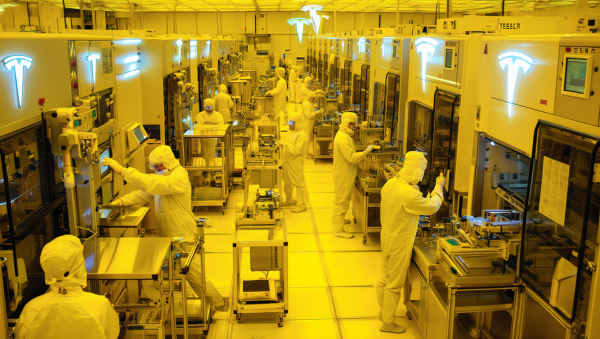
Tesla said it will pursue Terafab, a mega chip plant construction project to produce semiconductors in-house for autonomous driving and artificial intelligence (AI) technology, fuelling debate in the industry.
Business Insider reported on March 16 that Tesla Chief Executive Elon Musk (일론 머스크) recently announced on social media that Tesla’s chip plant construction project would begin within 7 days. The plant is reported to aim for production of ultra-fine semiconductors based on a 2-nanometre (2 nm) process.
Skepticism is widespread because Tesla is taking on a cutting-edge process despite having no experience in chip manufacturing.
The plan is being compared to Tesla’s in-house battery strategy unveiled at its 2020 Battery Day. At the time, the company introduced its next-generation 4680 battery cell and promised to build annual production capacity of 100 GWh by 2022 and cut battery costs by 56 percent.
But actual results fell far short of the goals. Industry estimates put Tesla’s 4680 cell production capacity at about 20 GWh a year as of early 2025. A dry-electrode process touted as a core technology proved more difficult than expected and was applied only in a limited way to cathodes, while anodes still rely on the existing wet process.
Performance improvements highlighted at Battery Day also did not materialise as much as expected. The 4680 cell was applied only to the Tesla Cybertruck for a period and did not achieve major commercial success. The battery supply chain later became unstable, and some suppliers sharply reduced business with the company.
Tesla has achieved some success in chip design. It developed custom Autopilot chips and the Dojo chip for AI training, building in-house semiconductor design capabilities. In that process, legendary chip designer Jim Keller (짐 켈러) and former Apple engineer Peter Bannon (피터 배넌) played key roles.
Many key talent have already left the company. Keller left in 2018, and Ganesh Venkataramanan (가네쉬 벤카타라마난), who led the Dojo project, also left in 2023. Musk later halted the Dojo project in 2025, and Bannon, the lead design executive, also departed.
Chip manufacturing staffing is a specialised field entirely different from design. It requires process engineers across lithography, etching, chemical mechanical planarisation, yield management and operation of EUV equipment, but Tesla is reported to have little experience in those areas.
Musk’s remarks also added to the controversy. Criticising cleanroom rules at semiconductor plants, he argued that he would build a factory where people could eat cheeseburgers and smoke cigars.
That prompted criticism from some quarters that Musk may not fully understand the complexity of semiconductor technology. The semiconductor industry says such remarks do not fit technical realities. Advanced chip plants operate in extremely strict cleanroom environments, such as ISO Class 1 to 3, and human breathing alone can generate millions of contaminant particles.
Nvidia CEO Jensen Huang (젠슨 황) also warned about the difficulty of advanced chip manufacturing. He said at a 2025 event, "Building advanced chip manufacturing is very difficult, and it takes more technology and experience than simply constructing a factory." He assessed that catching up with TSMC’s chip manufacturing capabilities is "virtually impossible."
In reality, advanced semiconductor production remains an area only a handful of companies can achieve. TSMC has built world-leading foundry capabilities by investing tens of billions of dollars over decades. Intel is also struggling to regain manufacturing competitiveness despite thousands of engineers and more than $100 billion in investment. Samsung Electronics has also not been able to catch up with TSMC in yields for advanced processes despite massive investment.
Against that backdrop, Tesla’s plan to build an ultra-fine 2 nm plant despite having no chip manufacturing experience is seen in the industry as a highly challenging goal. Some experts also see a possibility that Tesla could repeat a pattern seen in its past 4680 battery project, with schedule delays and scaled-back targets after announcing bold goals.
 Jinju Hong
hongjj@d-today.co.kr
Jinju Hong
hongjj@d-today.co.kr