
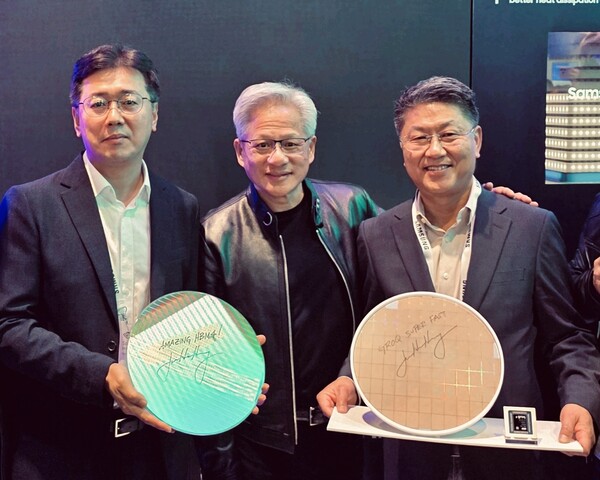
Nvidia CEO Jensen Huang visited Samsung Electronics' booth at GTC 2026 in San Jose, California. The Samsung semiconductors he looked over included products that fill the full range of Nvidia's next-generation artificial intelligence platform, from next-generation high-bandwidth memory (HBM) to server memory modules and storage.
Samsung said on March 17 that Huang personally signed Samsung's HBM4 core die wafer with the words "AMAZING HBM4" and a 4-nanometre wafer for Groq LPU foundry production with the words "Groq Super FAST". He also took a commemorative photo with Hwang Sang-jun (황상준), vice president in charge of memory development at Samsung Electronics, and Han Jin-man (한진만), head of its foundry business.
Groq, which Huang wrote, is an LPU (language processing unit) design company acquired by Nvidia and is developing processors specialised in ultra-low-latency token generation. At this GTC, Nvidia announced an LPX rack that combines Groq LPUs with GPU racks and said it will launch it in the second half of this year. Huang's signature is interpreted as a scene that publicly confirms Samsung is cooperating with Nvidia on both the HBM4 supply chain and Groq LPU foundry work.
Samsung's HBM4E, unveiled for the first time at this GTC, is also a reason Huang visited. Samsung presented a physical HBM4E chip and a core die wafer for the first time, based on its 1c DRAM process and its in-house 4-nanometre foundry. It is under development with a target speed of 16 Gbps per pin and bandwidth of 4.0 TB/s.
Samsung also unveiled hybrid copper bonding (HCB), a next-generation packaging technology, along with HBM4E. HCB improves thermal resistance by more than 20 percent versus thermal compression bonding (TCB) and supports stacks of 16 layers or more. While TCB bonds chips using heat and pressure, HCB directly connects chips through copper bonding to reduce heat generation and push stacking limits higher. Samsung plans to bring together its capabilities as an integrated device manufacturer (IDM) spanning memory, logic design, foundry and packaging for HBM4E development.
Samsung can potentially supply memory across the full Vera Rubin range... GDDR7 and LPDDR6 also on display
Samsung highlighted a total memory solution for Nvidia's next-generation AI platform, Vera Rubin, at this GTC. Samsung stressed it is the only company in the world that can supply all memory and storage within the Vera Rubin platform.
In the "Nvidia Gallery" zone showing areas of cooperation with Nvidia, HBM4 for Rubin GPUs, SOCAMM2 for Vera CPUs, and PM1763 storage were placed together with the Vera Rubin platform. SOCAMM2 is an LPDDR-based server memory module and has begun mass production shipments for the first time in the industry.
The PCIe Gen6-based server SSD PM1763 is Vera Rubin's main storage, and the booth demonstrated an Nvidia SCADA workload to show its operational performance. Samsung plans to supply PCIe Gen5-based PM1753 for the newly introduced CMX platform, aimed at improving AI inference performance and power efficiency.
Samsung also introduced a broad range of next-generation memory architectures at this GTC, including graphics memory GDDR7, mobile DRAM LPDDR6 and the server SSD PM9E1, in addition to the Vera Rubin solution. It highlighted that Samsung's memory portfolio spans the full range of AI infrastructure, from AI data centres to on-device AI and physical AI.
 Seok Dae-gun
d2dg@d-today.co.kr
Seok Dae-gun
d2dg@d-today.co.kr