
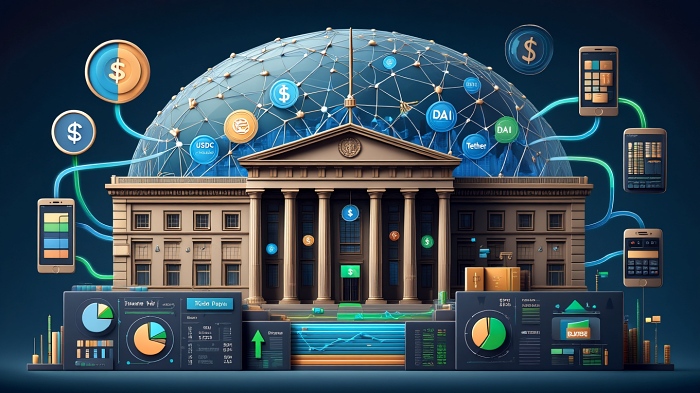
The global digital payments market is entering a phase of structural transition rather than gradual technological change. Payments no longer mean a simple act of paying. They are being reorganised into a core operating layer where financial regulation, technical infrastructure and industrial strategy intersect.
In 2026, the digital payments sector is likely to develop around stablecoins being brought into the regulated system, the spread of automated payments based on AI agents, and the practical use of on-chain payment and settlement infrastructure. The industry sees this period as a turning point from technical proof-of-concept to commercialisation.
◆ AI agents emerge as new actors in payments
A new pillar driving change in the 2026 digital payments environment is the "AI agent".
Web3 venture capital firm Hashed has defined 2026 as the "year of AI agent applications" and expects the structure in which AI agents collect and analyse data and autonomously carry out payments and transactions to take hold. In that case, the basic unit of economic activity would shift from individual or corporate user accounts to AI agents.
U.S. venture capital firm Andreessen Horowitz (a16z) argues that understanding and adopting systems for the concept of KYA (Know Your Agent), centred on AI agents, is needed rather than the existing KYC (Know Your Customer) concept for customers. It says the current financial environment has far more AI agents than humans, but they cannot participate as official financial actors because identity verification and regulatory frameworks are lacking. If a KYA system is built, real-time payments and value transfers between AI agents are expected to become possible.
The payment structure itself is also likely to change. Areas such as data purchases, GPU usage fees and API call costs already require automatic settlement. This is increasing demands that payments occur at the same speed as information flows. One example is "x402", cited as a new payment protocol, which aims for permissionless and immediate value transfers. In that case, an analysis suggests banks and payment networks could shift to back-end infrastructure that is not visible to users.
Traditional payment operators are also responding. Visa is running a "Visa Intelligent Commerce" pilot programme in cooperation with Skyfire, Nekuda, PayOS and Ramp. Transactions led by AI agents were reported to have actually taken place in the programme. It is also strengthening identity verification and security controls in an agentic commerce environment through cooperation with Akamai Technologies.
Mastercard has expanded its partnership with global payment processing company Fiserv to build an "Agent Pay" acceptance framework. It is implementing an AI-to-AI payment structure through it. This is seen as an example showing the card payment model expanding from a human consumer-centred structure to algorithm-based commerce.
◆ Stablecoins narrow the gap with legacy systems
The rise of stablecoins is also a major variable shaking the foundations of the digital payments market.
Stablecoins are growing fast enough to catch up with the expansion pace of existing payment infrastructure. According to Galaxy Digital Research, stablecoin transaction volumes have already surpassed global credit card networks such as Visa. They have now reached about half the transaction volume of the U.S. Automated Clearing House (ACH) system. Stablecoin supply is rising by 30 to 40 percent a year, and if that pace continues, it could surpass ACH transaction volume in 2026.
U.S. regulatory overhaul sits behind this trend. The GENIUS Act, passed in 2025, clearly sets out stablecoin reserve composition, redemption obligations and disclosure standards. It requires a 1-to-1 backing based on safe assets such as dollars or short-term U.S. Treasuries. The law is set to take effect in early 2026, and it is encouraging participation by financial institutions and companies that had delayed entering the market due to regulatory uncertainty.
Because of this, the industry is assessing that stablecoins are no longer just one type of cryptocurrency. Open World Chief Legal Officer Stephen Dallal forecast that "in 2026, stablecoins could be integrated into global payment networks and account for more than 10 percent of cross-border transactions". An analysis says this suggests structural features such as reduced remittance costs, faster payments and fewer intermediaries are beginning to operate in the real economy.
With stablecoin adoption spreading, competition with the existing financial sector is inevitable. Uphold CEO Simon McLoughlin said tokenised deposits could emerge as an alternative that digitises existing bank deposits on the blockchain while maintaining regulatory protections. This suggests competition between stablecoins and traditional finance could intensify.
◆ Stablecoins gain ground quickly in emerging markets
Practical use of stablecoins is expanding first in emerging markets rather than in advanced financial economies. In parts of Africa, Asia and Latin America, stablecoins are taking hold as tools for remittances and everyday payments. Global remittance service Western Union has launched a dollar-pegged stablecoin based on the Solana blockchain, and some assessments say it is being seen in some developing countries as a tool with higher value stability than local currencies.
Moves by global companies are also continuing in step with this. Sony Financial Group said it plans to issue a dollar-pegged stablecoin in the United States starting in fiscal 2026. The stablecoin is to be used for PlayStation and digital content payments. HSBC has flagged the introduction of tokenised deposits in the United States and the United Arab Emirates, and U.S. Bank is testing its own stablecoin on the Stellar blockchain.
Fintech companies are also preparing to enter the market. Swedish fintech company Klarna plans to launch "KlarnaUSD" in 2026. It highlights real-time settlement and low transaction fees as key competitive strengths. These cases show stablecoins are expanding into a general-purpose payment infrastructure rather than being limited to a specific industry or region.
2026 is expected to be when such infrastructure connects in earnest with the real economy. Stablecoin-based settlement, DeFi within regulatory boundaries, and real-world asset (RWA) tokenisation are presented as early signals. This is assessed as meaning digital assets and AI infrastructure have entered a mature stage.
◆ Digital payments market change, South Korea's tasks and options
South Korea's situation contrasts somewhat. Despite high demand for digital payments and rising stablecoin transactions, legislation has been delayed due to differences between government agencies over institutionalising a won-pegged stablecoin. Differences between the Bank of Korea and the Financial Services Commission over the issuing entity, licensing authority and scope of oversight remain unresolved.
In politics, some argue an open and competitive structure is needed, but there is also concern that the political calendar ahead of the 2026 local elections could weaken momentum for legislation. The industry continues to warn that if institutional uncertainty persists, South Korea could fall behind in competition over global payment infrastructure.
The 2026 digital payments market is likely to be reshaped around stablecoins entering the regulated system, the spread of automated payments based on AI agents, and the practical use of on-chain payment and settlement infrastructure. Overseas, traditional finance, big tech and fintech are entering the market at the same time on the back of clear regulatory frameworks, leading changes in payment infrastructure. In South Korea, assessments say the country stands at a crossroads where it could secure or miss opportunities depending on the direction of institutional design.
Payments no longer mean a simple act of paying. As automated financial infrastructure combining AI and blockchain begins operating in earnest, payments are evolving into a core operating system that simultaneously handles the movement of data, credit and assets. 2026 is expected to be a turning point when these changes move beyond conceptual debate and become visible in real industry and financial settings.
 Hyunwoo Choo
cookinpapa@d-today.co.kr
Hyunwoo Choo
cookinpapa@d-today.co.kr