
[DigitalToday reporter Shin-hye Ahn] South Korea's food industry is looking for a way out by targeting global markets instead of a prolonged slump in the domestic market. Instant noodles, dumplings and confectionery K-food are leading the push.
As of Feb. 19, the industry says food companies last year saw notable gains in overseas markets through K-food.
Samyang Foods delivered the most standout performance. Samyang Foods posted 2.35 trillion won in consolidated revenue last year, according to the Financial Supervisory Service's electronic disclosure system. That was up 36 percent from 1.73 trillion won a year earlier. It surpassed 2 trillion won two years after topping 1 trillion won in 2023. Operating profit jumped 52.1 percent to 523.9 billion won from 344.6 billion won, and net profit rose 42.9 percent to 387.6 billion won.
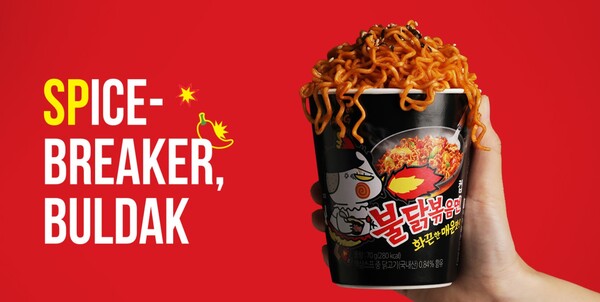
Samyang Foods has established an export-led model in which overseas growth drives overall expansion. The company is diversifying export destinations centred on the United States and Europe to strengthen the global foothold of its Buldak stir-fried noodle series. The industry says overseas sales accounted for nearly 80 percent of Samyang Foods' revenue due to the popularity of the series abroad. Samyang Foods raised production capacity by operating its second plant in Miryang to meet rising demand, and the Buldak brand sold about 1 billion units in the second half of last year alone.
CJ CheilJedang, Orion and Dongwon F&B are focusing on a portfolio diversification strategy that uses profits from overseas subsidiaries to defend against a weak domestic market.
The companies are struggling at home due to a weak won and rising raw material prices, while overseas they are preventing a fall in overall results by relying on their market dominance in key hubs such as the United States and China. They are also being assessed as managing earnings volatility without wasteful and costly competition among domestic firms, by sharing global shelf space with different flagship products such as dumplings and snacks.
CJ CheilJedang posted 17.75 trillion won in annual revenue last year, excluding CJ Logistics results. Overseas food revenue hit a record high of 5.92 trillion won and for the first time exceeded domestic revenue of 5.60 trillion won. The company plans to step up investment in its Global Strategic Products business, including dumplings, processed rice, kimchi, laver, and noodles, to expand K-food into new overseas territories.
CJ CheilJedang's CJ Food appointed Adam Ricciardone (아담 리치아르도네) as global chief technology officer on Feb. 12. He led R&D organisations in the consumer health industry for more than 30 years. The appointment was made to oversee a global growth agenda centred on Global Strategic Products. The company plans to draw up a strategic roadmap and build a collaboration system among regional overseas R&D organisations to raise cross-region synergy.
Dongwon F&B, the food affiliate of Dongwon Industries, also showed growth in global exports. Dongwon Tuna lifted U.S. export value by about 30 percent by using BTS member Jin as a model. Total exports rose more than 15 percent from a year earlier, led by home meal replacements, pet food and beverages.
Orion defended against stagnation in the domestic market caused by worsening conditions, rising raw material prices and a weak won by relying on global markets. It posted 3.33 trillion won in consolidated revenue and 558.2 billion won in operating profit last year, up 7.3 percent and 2.7 percent from a year earlier, respectively. Revenue grew 47.2 percent in Russia and 30.3 percent in India, and it expanded into markets including Europe and Africa to benefit from exports. In Russia, operating profit rose 26 percent to 46.5 billion won.
More recently, companies with a high share of domestic sales have joined the overseas drive as latecomers.
hy, formerly known as Korea Yakult, set up a joint venture with HYBE and moved to develop overseas markets by using the intellectual property of BTS, which had been the model for its coffee products. hy has sold Cold Brew special packages featuring BTS as models since 2018, and this time it is expected to use the IP of various HYBE artists in addition to BTS.
The move is seen as a strategic step to lower barriers to entering overseas distribution networks by using the fandom of K-pop artists as leverage at an early stage when brand awareness is low abroad.
The industry sees the rise of K-food as a key indicator that determines corporate sustainability, going beyond simple growth in export value.
A distribution industry official said, "With the domestic market's structural limits clear amid a prolonged downturn in domestic demand, boosting the share of overseas sales has become a survival strategy rather than a choice." The official added, "Company-specific strategies for overseas markets, such as improving the efficiency of local production systems, will likely decide winners and losers in the global market."
 Shin-hye Ahn
doubletap@d-today.co.kr
Shin-hye Ahn
doubletap@d-today.co.kr