
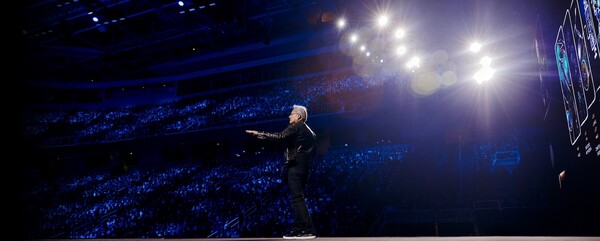
Nvidia will unveil at GTC 2026 a full-stack strategy for Physical AI spanning robotics and space. It tied industrial automation, autonomous driving, edge computing and space into a single expansion roadmap, and announced a "Physical AI Data Factory Blueprint" as core infrastructure to support it.
Nvidia's strategy of supplying infrastructure and a full software stack across robotics, autonomous vehicles, industrial automation and space took clearer shape at this GTC. If digital AI lifted demand for data-centre chips, Physical AI is a new growth axis for Nvidia hardware to penetrate edge devices, robots and spacecraft.
At an Nvidia media briefing held on the 16th, the company defined the fundamental issue in Physical AI not as a "lack of data" but as "compute is data". It said real-world data are too diverse and unpredictable to secure enough training data through deployment alone, and that only a structure that generates synthetic data directly with compute can resolve this bottleneck. Nvidia has put the Physical AI market at $100 trillion, 50 times the size of the IT industry, at about $2 trillion.
The Physical AI Data Factory Blueprint is what implements that. It is an open reference architecture based on the Cosmos world model and the Osmo orchestrator that ties the full pipeline into one, from data generation through simulation, evaluation and deployment. Previously, this process was spread across different pipelines and operated as a fragmented workflow. Adopting the blueprint allows synthetic data generation through model deployment to be handled on Nvidia infrastructure without building separate pipelines.
According to Nvidia, Microsoft Azure and Nebius are the first cloud adoption partners, and Field AI, Hexagon Robotics, Milestone Systems and Teradyne Robotics joined as first customers. The company said it also built its open models Alphama, Cosmos and Groot directly using this pipeline.
In the industrial software ecosystem, dependence on Nvidia is deepening. Major industrial software companies including Cadence, Dassault Systemes, PTC, Siemens and Synopsys said they are integrating Nvidia AI models along with CUDA-X and Omniverse libraries into their applications. They said this provides performance up to 100 times faster. Honda ran Synopsys Fluent on Grace Blackwell and shortened its development cycle by 34 times. Nvidia also said Samsung Electronics and SK Hynix are using Nvidia-accelerated electronic design automation tools on Dell and HP systems to raise semiconductor production efficiency.
◆ Vera Rubin Space Module... "orbital data centres to accelerate within the next few years"
In robotics, industrial robot companies ABB, Fanuc and Kuka have all adopted Omniverse libraries. Humanoid robot companies Figure, Hexagon, Agibot and 1X are building robot brains based on Isaac Lab, Newton and Cosmos libraries and Jetson Thor. Nvidia said all robotics companies are currently developing on its platform. "Groot N1.7", introduced as the world's first commercial humanoid robot inference model, was also unveiled at this GTC.
In autonomous driving, cooperation with Uber stands out. Uber plans to operate its entire Drive Hyperion-based robotaxi network with Nvidia's full-stack AV software. It will start pilots in Los Angeles and the Bay Area in 2027 and expand to 28 cities across four continents by the end of 2028. BYD, Geely and Nissan also newly adopted Drive Hyperion.
An integrated software safety foundation for Level 4 autonomous vehicles, called "Halo OS", was also announced. In edge AI, it is pushing AI RAN integration with Nokia and T-Mobile to put physical AI apps on telecommunications networks. It said there are now 1,500 Metropolis-based physical AI applications, and cited results including a fivefold speed improvement for Siemens Energy's automation of power-grid inspections and an 80 percent reduction in smart-city incident response time.
The final stage Nvidia is targeting for Physical AI is space. Nvidia announced at this GTC a space-optimised AI computing module called the "Vera Rubin Space Module". The goal is to perform real-time sensing, decision-making and autonomous operations in orbit. Aetherflux, Axiom Space, Planet Labs and Starcloud are participating as partners.
According to Nvidia, a GPU went into orbit for the first time last year, and full-scale transformation into space data centres is expected to take place within the next few years. The company said the final goal is to turn spacecraft into robotic systems and make orbital data centres tools for scientific discovery.
 Daegeon Seok
d2dg@d-today.co.kr
Daegeon Seok
d2dg@d-today.co.kr