
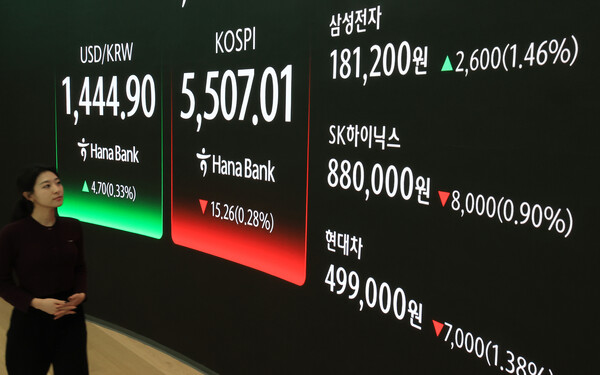
[Digital Today reporter Sangyeop Oh (오상엽)] With the KOSPI settling at the 5,500 level, attention is focused on its direction right after the Lunar New Year holiday. Past cases show the stock market generally rose after the holiday.
The KOSPI closed at 5,507.01 on the 13th, down 15.26 points, or 0.28 percent, from the previous day, ahead of the Lunar New Year holiday. It climbed as high as 5,583.74 during the session, eyeing a record high, but later turned lower amid profit-taking and a wait-and-see mood aimed at avoiding holiday risks.
It typically means share prices tend to rise as uncertainty is resolved during the Lunar New Year holiday period and demand for holiday standby cash winds down. Recent trends over the past 4 years also showed the probability of gains was higher.
On the first trading day after the 2022 Lunar New Year holiday period (Jan. 31 to Feb. 2), the index rose 1.67 percent on buying linked to perceptions it had fallen too much. After the 2023 Lunar New Year (Jan. 21 to 24), it also gained 1.39 percent, supported by a rebound in U.S. tech shares during the holiday. The day after the 2024 Lunar New Year (Feb. 9 to 12), it also climbed 1.12 percent on expectations for the government's corporate value-up program, with most periods showing gains.
But unconditional optimism is not advisable.
After last year's 2025 Lunar New Year holiday period (Jan. 28 to 30), the KOSPI fell. That was because debate over a tech-stock bubble, sparked by Chinese AI firm DeepSeek, and worries about a U.S. rate hold were reflected all at once during the holiday.
The KOSPI opened down 0.77 percent on Jan. 31 right after the holiday, then slid 2.52 percent on Feb. 3, freezing investor sentiment. That showed seasonal factors supporting gains may not work if external negatives emerge.
This year's situation is more complex. The KOSPI has posted an unprecedented rally since last year and reached the 5,500 milestone. The holiday comes with fatigue building after a sharp short-term surge.
Policy risks from the second Trump administration are also increasing volatility. The U.S. market has recently shown weakness, led by tech shares, weakening momentum for gains in South Korea's market.
This year, the Dow Jones Industrial Average is up 2.99 percent, but the tech- and mega-cap-heavy Nasdaq Composite and the Standard & Poor's (S&P) 500 are down 2.99 percent and 0.14 percent, respectively.
In particular, the market is closely watching U.S. economic indicators due to be released during the holiday.
The direction of the market after the holiday is likely to hinge on key indicators including the U.S. consumer price index (CPI) scheduled for release on the 16th and 18th local time. If inflation data come in higher than expected, expectations for Federal Reserve rate cuts could retreat, increasing volatility.
Experts advise focusing on risk management rather than aggressive chasing. They say investors may be exposed to volatility in overseas markets during the holiday, and should keep an appropriate cash allocation and watch market conditions.
A securities industry official said, "It is positive that past data show a high probability of gains after the Lunar New Year, but the current KOSPI level is a big burden and Trump-driven domestic and external variables are scattered," adding, "It is desirable to respond calmly while closely checking U.S. big tech share moves and economic indicators during the holiday."
 Sangyeop Oh
yub@d-today.co.kr
Sangyeop Oh
yub@d-today.co.kr