
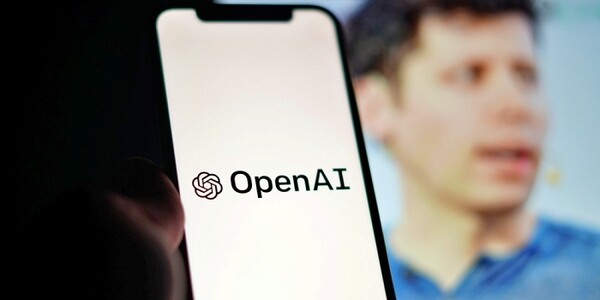
Sam Altman (샘 알트먼), CEO of OpenAI, made clear in a Harvard University lecture 2 years ago that he opposed the idea of putting ads into ChatGPT.
He said that if ChatGPT started showing paid ads as answers, people would lose trust in ChatGPT, OpenAI's flagship product. Altman added that advertising was an option OpenAI could choose last in its business model.
Yet OpenAI has recently begun showing ads in ChatGPT. How should that be interpreted?
OpenAI has poured tens of billions of dollars into computing power for AI development, but it is still struggling to secure revenue commensurate with that spending. Revenue is rising quickly, but it has not escaped a situation in which losses are also growing rapidly.
According to a recent report by the New York Times, OpenAI generated $13 billion in revenue last year. But OpenAI expects to spend about $100 billion more over the next 4 years.
Against that backdrop, playing the advertising card that it wanted to avoid as much as possible is a representative scene showing that increasing revenue has a very high priority inside OpenAI.
OpenAI has successfully attracted large-scale investment over the past few years. Leading venture capital firms and big tech companies have rushed to support OpenAI. But it is unclear whether that trend will continue as concerns grow about excessive AI investment. The number of places that can provide the money OpenAI needs to build computing power is bound to be limited. An initial public offering could be an alternative, but even OpenAI executives privately acknowledge that it would need to reduce losses to pursue an IPO, the New York Times reported.
OpenAI aims to triple revenue this year from a year earlier, but meeting that goal will not be easy. It is a scenario that can become realistic only if it delivers results in advertising and the enterprise market, where it has little or limited experience.
As of the end of last year, 60 percent of OpenAI revenue came from consumer products and 40 percent from business products. Most consumer product revenue comes from paid ChatGPT subscriptions. Of ChatGPT's 800,000,000 users, the share using the paid version is estimated at about 6 percent. Introducing ads into ChatGPT is a tactic to generate additional revenue from users of the free version.
But advertising could lower ChatGPT's value and, in the worst case, lead to users leaving, the New York Times reported.
The New York Times also cited online advertising industry experts as saying, "We believe AI chatbots like ChatGPT could ultimately generate annual advertising revenue worth billions of dollars, but that may require years of experimentation. While OpenAI conducts experiments, it will face competition from Google and other seasoned advertising companies."
Expanding into enterprise is also not easy.
Competition is formidable. Microsoft and Google have extensive experience selling software to the corporate market, and Anthropic, which is focusing on the enterprise market including coding AI, has also become an awkward company for OpenAI to face.
OpenAI is currently generating revenue in the enterprise market by selling Codex, its coding AI, ChatGPT Enterprise to support general office work, and an application programming interface (API) that companies use for app development.
Karl Keirstead, an analyst at investment bank UBS, said, "OpenAI has no choice but to push more aggressively into the enterprise software market." He added, "But ordinary companies may not want to pay such high fees for office software. Competition in the enterprise market is also intensifying, and Anthropic has emerged as a major rival in particular. While OpenAI struggles to generate revenue from both consumer and enterprise products, Anthropic is primarily focusing on developing business tools."
OpenAI has recently also said it will charge fees for scientific discoveries made using its AI tools, prompting controversy. The company later said it would affect only large pharmaceutical companies, but the New York Times reported that many independent researchers who use OpenAI tools are anxious.
 Chi-gyu Hwang
delight@d-today.co.kr
Chi-gyu Hwang
delight@d-today.co.kr