
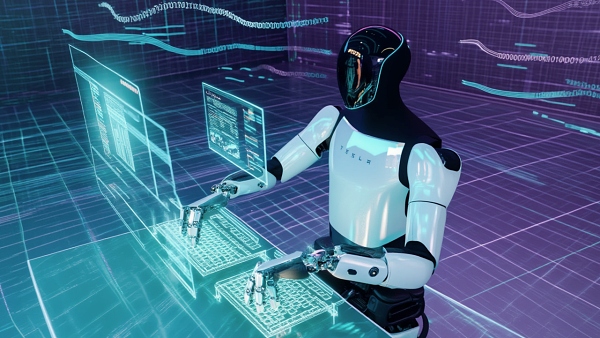
[DigitalToday reporter Hyunwoo Choo] Elon Musk (일론 머스크) has been dogged by controversy since unveiling the 'Macrohard' project, a joint initiative between his artificial intelligence (AI) company xAI and Tesla.
The Macrohard project, also known as Digital Optimus, aims to develop an AI agent that controls computers by combining xAI's large language model (LLM) Grok with the AI4 chip embedded in Tesla electric vehicles. The project is being carried out as part of a deal under which Tesla invests $2 billion (about 3 trillion won) in xAI.
Targeting Microsoft, the project is a plan to replicate the functions of a software company in full using AI. The name 'Macrohard' itself carries an antagonistic nuance, created by reversing Microsoft (Micro+Soft) into Macro+Hard.
The Macrohard project was first unveiled in August 2025. Musk claimed at the time via his X that software companies such as Microsoft do not build physical hardware themselves, so he would fully simulate hardware with AI himself.
It is a dual structure in which xAI's LLM Grok serves as a 'higher system' that establishes top-level strategy, while Tesla's AI agent Digital Optimus serves as a 'lower system' that processes real-time screen, keyboard and mouse inputs.
Macrohard or Digital Optimus is a joint xAI-Tesla project, coming as part of Tesla’s investment agreement with xAI. Grok is the master conductor/navigator with deep understanding of the world to direct digital Optimus, which is processing and actioning the past 5 secs of…
Behind Musk's flashy vision, however, lies a pile of unresolved challenges, including a leadership vacuum, the departure of key staff and a halt in data collection.
The biggest problem is internal. A Business Insider report on the 11th (local time) said the Macrohard project has had its leader replaced multiple times since launch. In February, 2 project leaders quit. xAI co-founder Toby Pohlen (토비 폴렌) then took over but left the company after just 16 days. Of about 20 engineers identified as belonging to Macrohard on LinkedIn and X, most are believed to have quit or moved to other teams in recent months.
Data collection work involving more than 600 outside contractors also stopped as of February. An internal memo said multiple defects were found in the model and changes were needed to the data collection method. It was initially expected to resume within 2 to 4 weeks, but it remains suspended as of this week.
Musk appears to be trying to break through the crisis by coupling the project with Tesla. Tesla's Autopilot team took over some Macrohard tasks and computing resources, and Digital Optimus adopted a method of processing real-time video streams rather than screenshots. The strategy is to transfer real-time video processing technology accumulated from developing the Full Self-Driving (FSD) system and the humanoid robot Optimus to the AI agent.
Macrohard project: changes Tesla's involvement could bring
Some in the industry believe Tesla's participation could create a new breakthrough for Macrohard. The key is hardware cost competitiveness. The system runs on Tesla's AI4 chip, priced at about $650 per unit, and uses xAI's costly Nvidia-based servers only in a limited way. The calculation is that it could sharply cut operating costs compared with competitors that rely entirely on cloud servers.
More notable is its distributed computing strategy. Tesla vehicles equipped with the AI4 chip can provide idle computing resources to the Digital Optimus network while parked. Tesla also plans to deploy several million dedicated Digital Optimus units at Supercharger sites, and the available power of the network is about 7 gigawatts (GW). Turning vehicles and charging infrastructure into AI computing hubs would effectively secure distributed AI computing infrastructure without separate large-scale data centres. This is seen as a structural advantage that other AI companies would find hard to replicate in a short time.
In the same context, Tesla first disclosed the number of FSD subscribers instead of vehicle delivery guidance in its fourth-quarter 2025 results announcement. Tesla effectively formalised its shift from an electric vehicle maker to an AI platform company, and Macrohard could become a key puzzle piece in that strategy.
Risks are also clear. Since 2024, Tesla shareholders have been pursuing a lawsuit for breach of fiduciary duty, alleging Musk siphoned Tesla's AI personnel and resources to xAI. The tie-up between the two companies through Macrohard could also further highlight the issues at the heart of the lawsuit. The project's target timeline is known to be around September to October this year, but it remains to be seen whether Musk's proposed schedule will lead to actual delivery.
Musk's plan to replace an entire software company with an AI agent remains ambitious. Despite repeated obstacles, Macrohard's second round carries different weight, given that Musk has restarted the project by mobilising Tesla's hardware and infrastructure assets.
Tesla's participation is not merely a change of relief pitcher but closer to a process of changing the rules of the game itself. Musk's declaration to 'replicate a software company in full' does not sound like mere bluff. In 2026, when the agent AI race gathers pace, the world is watching what impact Macrohard's new attempt will have on the AI industry's landscape.
 Hyunwoo Choo
cookinpapa@d-today.co.kr
Hyunwoo Choo
cookinpapa@d-today.co.kr