
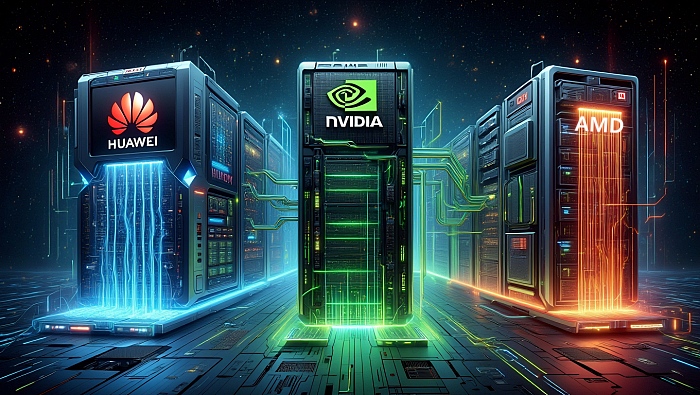
Nvidia still reigns as the strongest player in the artificial intelligence chip market, but signs of cracks are emerging in its dominance as Big Tech, startups and established semiconductor companies join the fray.
On March 14, Business Insider reported that a steady stream of competitors is emerging that could shake Nvidia’s dominance in the AI chip market.
The strongest challenger is Google. Google has been developing its Tensor Processing Unit (TPU) for 10 years and recently signed a deal with Meta to rent out TPUs. Amazon also designs its own AI chips and has introduced Trainium and Inferentia as alternatives to Nvidia. Microsoft has announced its Maia 200 AI inference chip, and Meta plans to develop a fourth-generation chip over the next 2 years.
What about startups? They are also moving to fight back. Nvidia is aiming to enter the inference chip market by acquiring AI chip developer Groq’s technology for $20 billion. Cerebras, founded in 2015 and valued at $23 billion, SambaNova, which participated in a Series E investment round, and Tenstorrent, recently valued at $2 billion, are also expanding their presence on the back of fundraising and cooperation.
China remains the biggest geopolitical headache for Nvidia. Jensen Huang (젠슨 황), Nvidia’s chief executive, has repeatedly warned that the tougher China regulations become, the faster local technology self-reliance could accelerate. Huawei is at the centre of this trend. It is speeding up development of its own AI chips to reduce reliance on Nvidia, while Alibaba and Baidu are also responding by applying their in-house AI chips to cloud businesses.
The AI chip market is not only about Big Tech and startups. Traditional semiconductor companies have also launched a full-scale counterattack. AMD has secured major customers such as Meta on the strength of its graphics processing unit competitiveness, and Intel is trying to expand market share by leaning on its solid base of corporate clients. Broadcom is building a stronger presence in networking and customised chip design, and it has created a structure that benefits it more as Nvidia tightens its grip on the GPU market.
The AI chip market, once seen as Nvidia’s one-man stage, is now moving into a full-fledged melee. From Big Tech such as Google and Amazon to startups, Chinese companies and established semiconductor powerhouses, each is looking for openings in different ways, and the battle for market leadership is expected to intensify.
 Yoonseo Lee
yslee@d-today.co.kr
Yoonseo Lee
yslee@d-today.co.kr