
[DigitalToday reporter Chi-gyu Hwang] A growing number of companies that drew little attention in performance and interest have quickly raised their profile as AI has taken off, and Corning, which specializes in glass technology, is considered one of them.
Corning, which boasts a 175-year history, recorded losses in its fiber-optic cable business over the past 20 years. Backed by the boom in building AI data centers, its shares are now heading toward an all-time high.
Major tech companies have also moved actively to cooperate with Corning. It is a scene that shows the strategic value of fiber optics in the AI data center race and Corning's standing in the fiber-optic market.
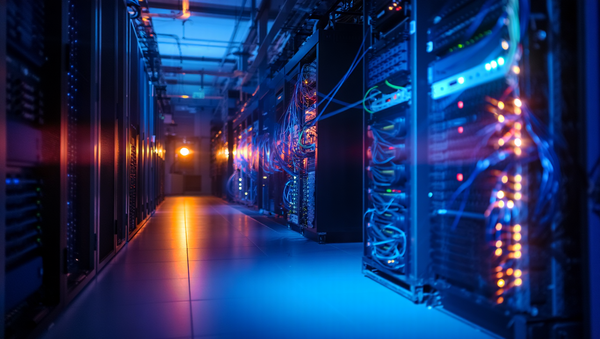
Until recently, fiber optics were mainly used to connect internet nodes, but they have now rapidly emerged as a key technology in AI data centers as well.
Fiber optics provide connectivity to AI data centers. For GPUs in AI data centers to perform properly, data transfer speed between GPUs and between data centers is important, and fiber optics are needed to support that. What matters here is fiber density. Higher-density fiber optics are needed to support greater throughput.
At the current point, Corning is assessed as one of the companies best at fiber optics. That is why its share price keeps rising. Corning CEO Wendell Weeks (웬델 위크스) said, "Even over short distances, transmitting data using photons is three times more efficient than using electrons. Over long distances, the gap reaches 20 times."
Corning continues to roll out factors that could be positive for its share price. Recently, it signed a $6 billion fiber-optic contract with Meta.
According to the Wall Street Journal (WSJ), Corning is also in talks on similar deals with several companies besides Meta. Corning is developing fiber optics that go inside servers as a next-generation business, beyond simply connecting servers. Nvidia is reviewing a plan to directly integrate Corning optical technology into servers.
Corning's expansion of its foothold in the AI arena began in 2018, triggered by a visit by company executives to a Meta data center, then called Facebook. Until then, Corning had been producing a product that had not changed much since it was introduced in the 1970s.
According to the WSJ, Corning executives were said to have been greatly surprised by the demand for fiber-optic cables needed to connect every server in a massive Facebook data center. Facebook was using a mix of copper cables and existing fiber optics, but concluded that neither was suitable for the task.
Corning moved quickly from that point. Corning engineers began speeding up efforts to make the cable thinner, yet stronger, so it could withstand sharply bent environments. Corning was not betting with conviction on AI data centers, but the result was a winning move. Five years after Corning executives visited Meta, ChatGPT debuted and demand for fiber-optic-based data centers exploded, the WSJ reported.
Reinventing fiber optics for AI is not unrelated to Corning's keeping its distance from outsourcing. Corning even designs the machines used to manufacture fiber optics and cables. Corning also operates nearly half of its manufacturing facilities in the United States. That contrasts with many companies that have moved advanced manufacturing infrastructure overseas.
 Chi-gyu Hwang
delight@d-today.co.kr
Chi-gyu Hwang
delight@d-today.co.kr