
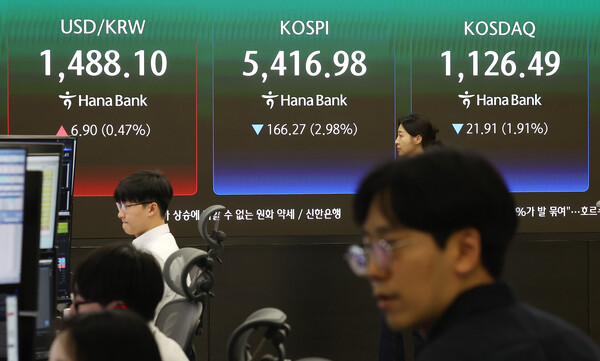
[Digital Today reporter Sang-yeop Oh] South Korean stocks are expected to focus this week on the U.S. Federal Open Market Committee (FOMC), the U.S. producer price index (PPI) and Nvidia GTC (GPU Technology Conference) as Middle East-driven geopolitical risks add to short-term volatility.
The KOSPI ended last week at 5,487.24, down 1.75 percent from the previous week. The Kosdaq finished weekly trading at 1,152.96, down 0.15 percent. Retail and institutional investors posted net buying of 81.101 trillion won and 125.7 billion won, respectively, helping defend the downside. Foreign investors sold a net 80.619 trillion won.
This week’s key variable is the FOMC meeting scheduled for March 17 to 18 local time. With a policy-rate hold seen as a done deal, the market is watching the dot plot and economic projections, and whether the Federal Reserve interprets the recent rise in oil prices and inflation pressures as temporary factors.
Inflation data also matter. If the February U.S. PPI, due on March 17 local time, comes in higher than expected, worries could grow that higher oil prices may feed into consumer inflation.
Nvidia’s GTC conference, running March 16 to 19 local time, is also a key factor. Next-generation GPU architecture and an AI infrastructure roadmap are set to be unveiled, and the event is expected to provide an opportunity to recheck the sustainability of the AI investment cycle that has supported the market recently.
Micron earnings, a bellwether for global high-bandwidth memory (HBM) makers, are expected to be a gauge of where the AI industry is headed. Micron is set to announce quarterly results on March 18 local time.
China-related factors also need to be checked. Real-economy indicators such as February retail sales and industrial output are due on March 16, and a loan prime rate (LPR) decision is scheduled for March 20, meaning whether China’s growth momentum is recovering could affect investor sentiment toward South Korean exporters.
South Korean stocks could again see wider intraday swings this week depending on developments in international issues. Still, if the war does not drag on for more than 3 months, policy and earnings drivers could come back into focus and the market’s attention is expected to gradually shift from geopolitical concerns to corporate fundamentals.
Yeom Dong-chan (염동찬), a researcher at Korea Investment & Securities, said, "Volatility has eased somewhat, but it is a time when a reasonable approach to the KOSPI’s lows is needed given that war risk remains and crude supply risk also remains." He added, "Volatility is still not stabilised, but given the index level, it is a level that can be approached by buying on declines."
Jung Hae-chang (정해창), a researcher at Daishin Securities, added, "Market sensitivity is gradually easing, and after going through two circuit breakers, it confirmed support at the 5,000 level on the KOSPI." He added, "The market’s attention will gradually shift from geopolitical concerns to the real economy and corporate fundamentals."
 Sang-yeop Oh
yub@d-today.co.kr
Sang-yeop Oh
yub@d-today.co.kr