
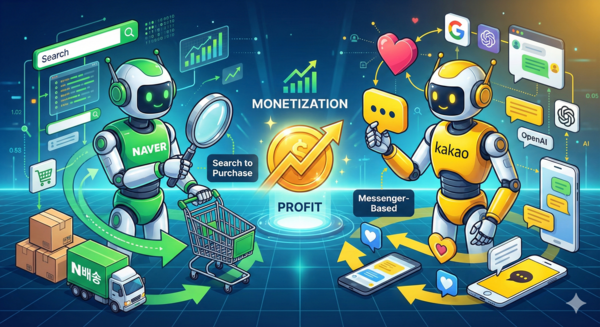
Naver and Kakao posted their best-ever results last year and will move into a full-fledged competition this year in “agent” services using generative artificial intelligence (AI). Naver is seeking differentiation with action-conversion AI that takes users from search to purchase, while Kakao is focusing on messenger-based, everyday-life AI.
◆Naver seeks commerce lead with 'search→action conversion' AI
Naver has completed verification of AI Briefing and set this year as the first year of expanding agent AI. After the launch of AI Briefing last year, long-tail queries of 15 characters or more doubled, and clicks on follow-up questions rose sixfold, confirming changes in user behaviour. By the end of this year, it will double the current AI Briefing coverage of 20 percent of search queries and, from the second half, test ad monetisation in shopping and place services.
Based on this verification, Naver will shift from providing information to supporting execution. Starting with a shopping agent in late February, it will sequentially launch vertical agents for restaurants, travel and finance. Combined with the conversational AI search “AI Tab” to be introduced in the first half, it will support action conversion including purchases, reservations and orders.
Naver CEO Choi Soo-yeon (최수연) said, “Based on Naver’s unrivalled user data and advanced reasoning capabilities, AI will proactively intervene to provide a new experience that supports the entire search journey.”
It also pursued AI infrastructure efficiency. Through integrated GPU operations and a shift to lightweight models, it cut inference costs by more than 30 percent. Of the 8.8 percent growth rate in total platform advertising sales in 2025, AI contributed 55 percent, and the number of performance-based advertisers more than doubled from a year earlier.
A key goal is to link AI-driven growth to commerce. It will expand N Delivery coverage to 25 percent this year, 35 percent next year and more than 50 percent within 3 years, making delivery “a reason to choose, not a constraint.”
Choi said it would keep all possibilities open across partnerships, infrastructure and operations to fundamentally boost delivery competitiveness. It aims to increase active membership users by more than 20 percent from a year earlier and targets double-digit growth in Smart Store transaction volume. In advertising, it is expanding to external media, offsite and local ad markets, and has been conducting an offsite linkage test with Meta since late November.
◆Kakao seeks ad profitability recovery with 'on-device AI'
Kakao recorded a 2025 operating profit of 732.0 billion won, up 48 percent from a year earlier, after cutting affiliates from 150 to 94 and focusing capabilities on core businesses. This year it is focusing on combining AI with KakaoTalk.
Kakao’s differentiation strategy is on-device AI. “Kanana in KakaoTalk,” set for an official launch in the first quarter, saw more than 80 percent of invited users download the model in its closed beta test, and 70 percent continued using it. The key is the AI’s “first message” function. More than 60 percent of total interactions began with the AI speaking first.
Kakao CEO Jeong Shin-a (정신아) said the AI’s role of speaking first based on user conversation context is “a powerful moat that only Kakao can implement.”
In the closed beta test, commerce emerged as a major usage scenario, following schedule reminders and briefings. Kakao said it confirmed clear business opportunities in the commerce domain and will actively build contexts in the first half where transactions can take place. Its AI services also led to longer time spent on KakaoTalk. Average daily time spent by users of ChatGPT for Kakao and Kanana in KakaoTalk rose by about 4 minutes in the 2 months before and after service use. Users of ChatGPT for Kakao increased from 2 million to 8 million from launch to now. Kakao judged it could achieve its goal this year of “expanding KakaoTalk user time spent by 20 percent.”
Global partnerships are also accelerating. Kakao has started direct collaboration with Google’s Android development team, operating TPU cloud and cooperation on AI glasses. With OpenAI, it will strengthen connectivity between KakaoTalk conversation context and ChatGPT. Jeong said it is working with Google on device experiences and with OpenAI on business-to-consumer services, building partnerships in areas that do not overlap. Through “Play MCP” and “Agent Builder,” it will connect external partners and bring in at least 3 major commerce players within the first half.
A key goal is to link longer time spent and building agent commerce to recovering ad profitability. Talk display advertising, which had been shrinking for 5 consecutive quarters, recorded a turnaround with 18 percent growth in the fourth quarter from a year earlier. The introduction of feed-type ads improved advertiser return on ad spend, and inflows of small and mid-sized commerce advertisers expanded.
From the second half, it will shift commerce placements to an open sales structure, introduce automated bidding and boost ad efficiency with AI-based “Moment AI.” It targets double-digit growth in business messages through expanding brand messages, and aims to maintain double-digit annual growth in Tokbiz advertising. It presented goals of more than 10 percent annual consolidated revenue growth this year and a 10 percent operating profit margin.
Naver CEO Choi Soo-yeon (최수연) said, “This year, through shopping agents and AI Tab, we will create new value and monetisation opportunities while continuing strategic investment centred on content, AI infrastructure and N Delivery, focusing on accelerating revenue growth.”
Kakao CEO Jeong Shin-a (정신아) said the results of structural improvements that focused group capabilities on the core “clearly appeared in financial indicators.” She said, “We will prove performance through improved results while showing expectations for Kakao’s mid- to long-term growth with tangible outcomes.”
 Lee Ho-jung
lhj@d-today.co.kr
Lee Ho-jung
lhj@d-today.co.kr