
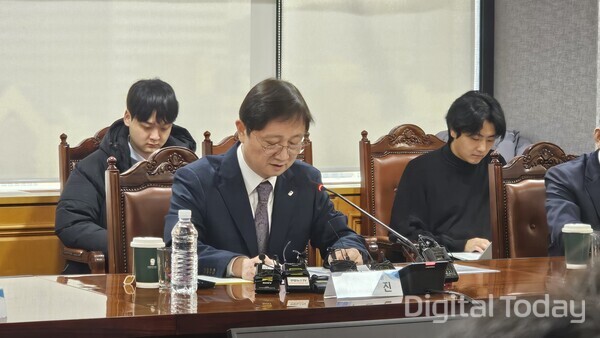
Ahead of the final announcement of penalties related to the Hong Kong H-index ELS incident, the heads of financial authorities and banks met in one place. With urgent issues piled up, from managing household debt to sales practices for high-risk products and governance restructuring, the Financial Supervisory Service put banks' role front and center and issued strong demands.
Lee Chan-jin (이찬진), head of the Financial Supervisory Service, held a meeting on Feb. 12 with the chiefs of 20 domestic banks and said that as social demands grow for financial consumer protection and stronger internal controls at financial companies, the banking sector's role has become more important than in the past.
He voiced concern that loans to households and self-employed people, which have risen sharply since the pandemic, along with real estate-related exposure, could act as potential risk factors for the economy and financial system.
The key was managing household debt. Lee said he would support stable management of household debt and rationalise capital regulations so that bank funds can flow into productive sectors.
The Financial Supervisory Service plans to manage growth in household lending within the nominal growth rate, aiming to stabilise the household loan ratio relative to GDP at a lower level. Within the Basel III framework, it also plans to improve risk weights applied to equity and fund exposure. For equities and funds related to specific government economic support, it plans to clarify the criteria for applying special risk-weight treatment to ease capital burdens.
Lee also pointed again to banks' profit structures. He stressed that banks should actively supply funds to innovative companies and small and medium-sized firms rather than settling for easy interest income. The message was to move away from "interest-based business" that relies on expanding household lending and shift toward productive finance.
He also called for expanding inclusive finance. He asked banks to re-examine practices of extending the statute of limitations and to actively inform debtors about systems that provide real help, such as a "living expenses account" and a "long-term installment program" to support victims of jeonse rental fraud. The Financial Supervisory Service plans to provide institutional support by promoting "linked supply chain finance" and introducing a "comprehensive evaluation system for inclusive finance."
◆ With ELS sanctions ahead, call for 'gyeonri-saui'... supervision shift to consumer protection
Coincidentally, the day came as tensions inside and outside the banking sector peaked ahead of the final release of the sanctions review results on the Hong Kong H-index ELS incident. Controversy is also continuing, with the Korea Financial Industry Union holding a second news conference the previous day to question the level of sanctions and the appropriateness of applying the Financial Consumer Protection Act.
Lee said that large-scale losses and disputes over misselling that occurred in the sales process of high-risk investment products, including the Hong Kong H-index ELS incident, were still ongoing, and he strongly pointed to damage to consumer trust.
He also said banks must make "gyeonri-saui" a core value in management, referring to the idea of thinking first of righteousness when seeing profit.
He also called on banks to re-examine the entire process of designing, reviewing and selling financial products from a "consumer protection perspective" and to establish a KPI system centred on consumer protection that matches it.
The Financial Supervisory Service also decided to shift its supervisory stance toward consumer protection. After recently reorganising its structure around consumer protection, it will fully switch to a risk-based, "preemptive consumer protection system" under a "roadmap to improve financial consumer protection."
During regular inspections, it will separately form a consumer protection inspection team and revamp the evaluation system for the status of financial consumer protection. It plans to build a supervisory system that monitors the full process, from product design to post-sale dispute mediation, and to put the emphasis on prevention rather than post hoc sanctions.
◆ Governance overhaul foreshadowed... 'Do not wait for制度, take preemptive measures'
Bank governance innovation was also put on the agenda. Through the governance advancement task force currently in operation, improvement measures and an amendment to the governance law are to be prepared, including strengthening board independence, improving fairness and transparency in CEO selection and rationalising performance-based pay systems.
Lee asked banks not to wait for institutional improvement, but to proactively 추진 necessary measures and boldly fix areas that need improvement. It was analysed as pressure that while the supervisory authorities present the direction, substantive change must be created by the banks themselves.
He said that although the financial environment is changing rapidly due to AI development and digital transformation, he will firmly uphold the basic values of financial consumer protection, financial market stability and development of the financial industry. He also said he would continue communication, including meetings with the banking sector, so that voices from the field are faithfully reflected in supervision and inspection work.
Cho Yong-byung (조용병), chairman of the Korea Federation of Banks, replied that he agreed banks must contribute to national economic growth by supplying funds to productive sectors, and said the banking sector would join forces to strengthen consumer protection and improve governance, meeting the public's higher expectations.
Bank chiefs also said they would actively participate in institutional improvements to expand productive finance and inclusive finance, and would together seek measures to enhance financial consumer rights and interests such as simplifying procedures for personal debt adjustment.
A banking official said the authorities' message was clear on household debt management, the ELS backlash and governance restructuring. The official said it meant sales that rely on "easy interest income" would no longer be tolerated, and that it appeared to keep emphasising that a bank's reason for being rests on consumer trust.
 Ji-young Lee
ljy@d-today.co.kr
Ji-young Lee
ljy@d-today.co.kr