
Dassault Systemes, at its annual SolidWorks conference 3DExperience World 2026 held from Feb. 1 to 4 (local time), put forward natural language-based generative AI that can be used for engineering as a key message, rather than a large language model (LLM)-based chatbot.
The company’s new virtual companions Leo and Marie support tasks ranging from 3D modelling to advanced engineering. They play a role like engineers responsible for physics-based analysis across structure, mechanical, simulation and manufacturing. Marie handles more scientific areas such as materials in the design process.
Dassault Systemes stresses that for Leo and Marie to work in practice, companies need to have engineering data governance in place. At 3DExperience World 2026, data governance was also one of the key keywords supporting engineering AI.
According to the company, data governance centres on optimising data classification and sharing policies to fit AI. It may not look like much, but it is seen as harder than expected when companies actually try to do it. That is especially true when there is little collaborative culture inside an organisation.
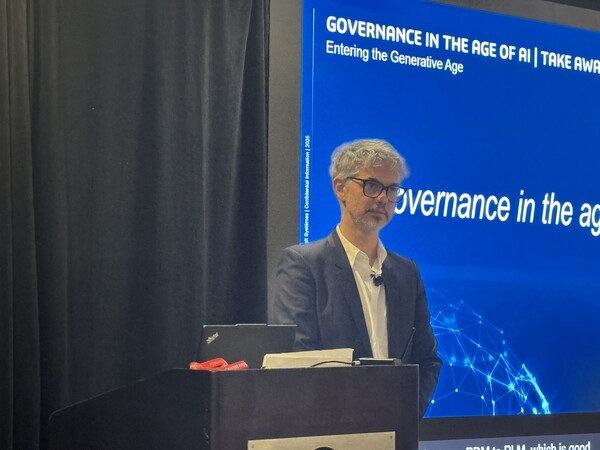
Yannick Audoir (야닉 오두아르), vice president in charge of Dassault Systemes ENOVIA, called for a shift in awareness about governance at 3DExperience World 2026 and emphasised 3 keywords.
He focused on what experience ENOVIA provides in terms of governance.
ENOVIA is a product lifecycle management (PLM) solution that enables collaboration, data management and knowledge sharing across the entire product development process. It is cloud-based and supports companies in connecting and integrating data generated across product development, manufacturing and service.
The keywords Audoir presented are summed up as governance that is not about simply providing AI functions, but about giving execution capability in the workplace: invisible, forward and supercharged governance.
According to him, Aura, a virtual companion Dassault Systemes launched last year, is a core pillar in task and meeting management. For example, when a designer selects a priority task suggested by Aura, the relevant design environment is automatically prepared. When a task is completed, Aura automates approval, release and tracking so it does not interrupt the user’s workflow. During meetings, it summarises and structures conversations in real time, assigns tasks and connects them to a virtual twin, supporting automatic follow-up actions.
In knowledge management, Aura offers “cross-document insights” that supports natural language searches of information inside documents, along with summaries and source tracking. Documents on external corporate platforms are also included as analysis targets, making it usable without switching existing systems.
ENOVIA’s governance strategy is also drawing attention in terms of “forward”. The company says it presents immersive AI-based workflows for various roles including designers, supply chain staff and project leaders across product release, change management and parts sourcing.
Audoir said, "In the release process, it guides designers on requirements, and in change management it provides impact analysis and suggestions reflecting industry best practices to minimise work conflicts."
The final strategic axis, “supercharged governance”, supports AI in supplementing decision-making that is difficult for administrators to handle. Project leaders can use Aura to view schedule, risk and team sentiment data in an integrated way, and reflect even workforce redeployment.
In regulatory response as well, it becomes possible to implement “design-based compliance”, where AI converts documents into requirements and identifies the scope of impact by linking them to design.
Audoir also highlighted AI-based supplier insights to respond to supply chain disruption. He explained that based on data integration capabilities spanning external systems, Aura identifies risks early, suggests required actions and speeds recovery. He also said, "Industrial AI should not simply show information, but should provide insights that users can act on immediately," and stressed that "execution-focused AI combining virtual twins, cross-platform AI and 40 years of industrial knowledge makes that possible."
 Chi-gyu Hwang
delight@d-today.co.kr
Chi-gyu Hwang
delight@d-today.co.kr