
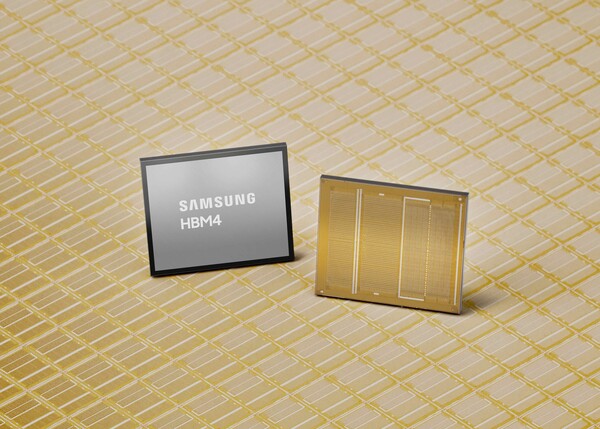
Samsung Electronics said on Wednesday it has begun mass production shipments of HBM4, a next-generation high-bandwidth memory product, claiming it is the first in the world. It secured an operating speed of 11.7 Gbps, 46 percent faster than the industry standard set by JEDEC, and improved power efficiency 40 percent from the previous generation. Samsung Electronics forecasts its 2026 HBM sales will increase more than threefold from a year earlier.
The HBM4 uses 1c (10-nanometer-class sixth-generation) DRAM and a 4-nanometer base die. Samsung Electronics said it set performance targets exceeding JEDEC standards from the start of development, and preemptively introduced leading-edge processes, breaking with the previous practice of applying already validated processes. It said the product secured stable yield and performance from the initial stage of mass production without redesign.
Hwang Sang-joon (황상준), a vice president in charge of memory development at Samsung Electronics, said, "By securing sufficient headroom for performance scaling through process competitiveness and design improvements, we were able to meet customers' demands for higher performance in a timely manner."
Key performance indicators show the operating speed was stably secured at 11.7 Gbps, 46 percent above the JEDEC industry standard of 8 Gbps. It can be implemented up to 13 Gbps. That is about 1.22 times higher than the maximum pin speed of 9.6 Gbps for the previous HBM3E.
Total memory bandwidth improved about 2.7 times from HBM3E to a maximum of about 3.3 TB/s, exceeding the customer requirement of 3.0 TB/s. Capacity ranges from 24 GB to 36 GB through 12-high stacking technology, and the company plans to expand it to up to 48 GB by applying 16-high stacking technology in line with customer product schedules.
HBM4 doubled the number of data transfer I/O pins to 2,048 from 1,024. That creates issues of power consumption and heat concentration. Samsung Electronics applied low-power design technology to the core die and cut the voltage of the through-silicon via (TSV) drive circuit to 0.75 V from 1.1 V, reducing TSV drive power by about 50 percent. It also optimized the power distribution network (PDN).
As a result, energy efficiency improved about 40 percent, thermal resistance about 10 percent, and heat dissipation about 30 percent from the previous generation. For data center operators, it can reduce power consumption and cooling costs at the server and data center level while increasing GPU computing performance.
HBM4E in second half, custom HBM samples slated for 2027
Samsung Electronics expects 2026 HBM sales to increase more than threefold compared with 2025 and is expanding HBM4 production capacity in advance. Requests for cooperation on HBM supply are continuing from major global GPU makers and hyperscaler customers that design their own chips.
As the basis for supply stability, Samsung Electronics cited that it is the only integrated device manufacturer (IDM) in the world that can provide a "one-stop solution" spanning logic, memory, foundry and packaging. It stressed that close DTCO (design-technology co-optimization) collaboration is possible between its own foundry process and HBM design, and that it also has advanced packaging capabilities in-house, allowing it to minimize supply chain risk and shorten production lead times.
On the infrastructure side, it stressed that it has capabilities to respond flexibly to expanding demand based on the industry's largest DRAM production capacity and cleanrooms secured in advance. Pyeongtaek plant Complex 2 Line 5, set to begin full operation from 2028, is expected to be used as a key base for HBM production.
The next-generation roadmap is also being detailed. HBM4E, which further boosts HBM4 operating speed, bandwidth and power efficiency, is scheduled for sample shipments in the second half of 2026. Custom HBM, which is tailored in capacity, speed and power characteristics to match customers' AI accelerators and GPU architectures, will begin sequential sampling by customer from 2027, the company said.
A Samsung Electronics official said, "The quality and supply stability based on the 1c process secured during the mass production of HBM4 will be an important competitive factor in the transition process to high value-added products such as HBM4E and custom HBM."
 Seok Dae-geon
d2dg@d-today.co.kr
Seok Dae-geon
d2dg@d-today.co.kr