
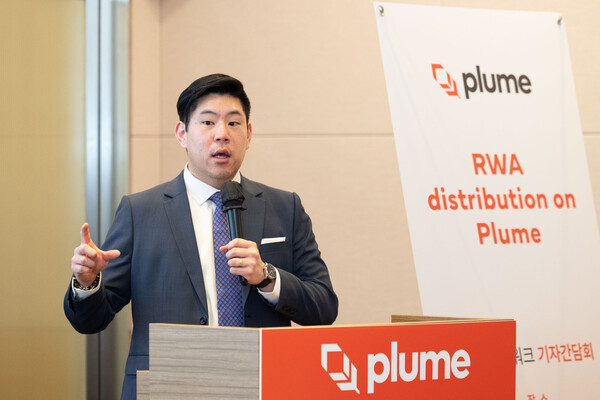
Plume Network, a layer-1 blockchain optimised for real-world assets (RWA), is stepping up its expansion in the South Korean market. After supporting the won-pegged stablecoin KRW1 in cooperation with digital asset custody firm BDACS, it is also expanding cooperation with various communities and users.
Chris Yin (크리스 인), CEO of Plume Network, visited South Korea on Feb. 12 and held a press briefing. "In Korea as well, with legislation, a token securities (STO) system is set to be implemented in earnest in 1 year, and many companies are already preparing infrastructure," he said, repeatedly stressing that he sees Korea as a strategic base. He said Korea is a market that has both a retail-centred structure with high trading turnover and competitive underlying assets as a cultural and economic powerhouse. "We will play a bridge role by putting Korean assets on-chain and distributing them to global investors," he said.
Plume Network has surpassed $400 million in TVL (total value locked, the total value of assets locked in the network) since opening its mainnet last year.
According to the company, the global RWA market expanded to $18.8 billion from about $5.5 billion early last year. Treasury-backed products led the growth, and institutional funds and private credit are also increasing rapidly. However, the total number of RWA holders is about 800,000. It is still in an early stage compared with traditional financial markets.
Differences stand out by product. BlackRock's tokenised Treasury fund BUIDL is about $1.8 billion in size, but has only around 100 holders. Ondo's OUSG is also more than $700 million, but has fewer than 100 holders. TVL has grown, but the structure depends on a small number of large pools of capital.
DeFi protocols such as Sky (Maker) and Pendle secured tens of thousands of users despite relatively small TVL. He explained that their design for accessibility, liquidity and usability led to wider user adoption. "The RWA market has grown in size, but market participants are very limited," Yin said. "Whether RWA succeeds depends not on listing assets, but on distribution and accessibility. The distribution structure is key," he said.
Plume Network is focusing on building a "full-stack RWAFi chain" to expand access to RWA. Rather than simply issuing tokens, its strategy is to vertically integrate the process from issuance to management to distribution, enabling assets to be used immediately. It aims to secure distribution networks by connecting exchanges, broker-dealers and fintech partners on that basis. It also highlighted competitiveness on the regulatory side by securing U.S. Securities and Exchange Commission (SEC) transfer agent registration and an Abu Dhabi Global Market (ADGM) commercial licence.
Yin said it could take a considerable amount of time for the RWA market to become established. "If you look at current on-chain assets, short-term Treasuries account for a large share. Once a belief forms that tokenised assets are safe, users will gradually seek higher returns," he said. "The recent growth of private bonds also reflects this flow," he said.
 Chi-gyu Hwang
delight@d-today.co.kr
Chi-gyu Hwang
delight@d-today.co.kr