
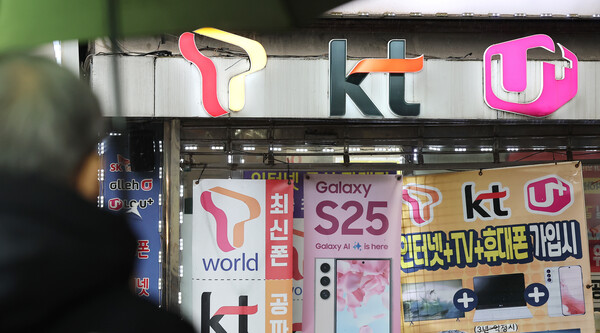
[DigitalToday reporter Jin-ho Lee (이진호)] South Korea's three mobile carriers last year returned to combined operating profit above 4 trillion won. It was the first such result in 2 years since 2023. The impact of a hacking incident and subscriber shifts sharply split results by company.
SK Telecom fell sharply due to the fallout from a SIM hacking incident, while KT and LG Uplus posted solid performance. The three carriers this year will push a full-scale shift in their business structures by promoting AI-based new businesses such as AI, data centres and AI contact centres (AICC).
Diverging results among the three carriers... SKT weak, KT and LG Uplus grow
On Feb. 11, the industry tallied combined revenue of 60.7951 trillion won and operating profit of 4.4344 trillion won for SKT, KT and LG Uplus. Revenue rose 3 percent from a year earlier and operating profit climbed 26.8 percent.
Overall results recovered on a combined basis, but the scorecards diverged by company. SKT last year posted revenue of 17.0992 trillion won and operating profit of 1.0732 trillion won. Revenue fell 4.7 percent and operating profit dropped 41.1 percent from a year earlier. Customer losses and response costs tied to the hacking incident hurt results. Its 40 percent market share threshold was broken and the impact of a decline in wireless subscribers continued. SKT decided not to pay dividends in both the third and fourth quarters last year as results worsened.
KT, meanwhile, delivered record results. KT last year posted revenue of 28.2442 trillion won and operating profit of 2.4691 trillion won, up 6.9 percent and 205 percent, respectively, from a year earlier. One-off factors were reflected, including a base effect from large-scale voluntary retirement in 2024 and one-time gains such as real estate presale profit from its Gangbuk headquarters. Another reason for the strong performance was that the fallout from an unauthorised small-amount payment incident was not fully reflected in last year's results.
LG Uplus also continued steady growth. LG Uplus last year posted revenue of 15.4517 trillion won, up 5.7 percent from a year earlier. Operating profit rose 3.4 percent to 892.1 billion won. Expanding new B2B businesses and improving cost efficiency were seen as supporting its performance.
Subscriber switching also widened the performance gap. In the fourth quarter of last year, SKT's wireless subscription lines (mobile plus budget phones) totalled 33,365,000, down 2.7 percent from a year earlier. KT and LG Uplus benefited in turn. KT's wireless subscription lines rose 10.9 percent to 28,985,000 from a year earlier. LG Uplus increased 7.7 percent to 30,711,000.
The shift is expected to affect this year's results as well. SKT said on a conference call, "Revenue this year will not reach the 2024 level due to a decrease in wireless subscribers." KT said, "Although 230,000 customers left due to the waiver of early termination fees, subscribers increased on a net basis for the year. This net increase will form the basis for generating 2026 wireless revenue."
Strengthening growth engines with AX... all-out effort to find new revenue sources
The three carriers plan to put full effort into expanding AI businesses this year. SKT plans to strengthen competitiveness in AI-based services by upgrading its proprietary large-scale AI model, 'A.Dot X (A.X) K1'. It aims to apply AI across its telecommunications services and accelerate AI monetisation. It also sees its data centre (AIDC) business as a key growth pillar. SKT is reviewing a plan to expand the capacity of an AIDC project under way with Amazon Web Services in Ulsan to more than 1 GW. It aims to secure long-term infrastructure competitiveness to meet rising demand for AI training and inference.
KT is speeding up its push into the B2B market focused on AI and cloud. It is seeking to secure corporate customers through offerings including its independently developed AI model 'Mideum K', a Korea-specialised AI language model 'SOTA K' based on its partnership with Microsoft, and a security-focused cloud service 'SPC (Secure Public Cloud)'. It also plans to expand data and AI business opportunities focused on the financial sector through cooperation with Palantir. KT Chief Financial Officer Min Jang (장민) said, "As it will be difficult to expect rapid growth in the wireless business, we will improve operational efficiency to protect profitability."
LG Uplus is seeking differentiation by expanding its AI agent, 'Iksio', across companywide services. The goal is to apply AI not only to customer consultations and corporate services but also to network operations, internal work automation and overall management of corporate customers. In particular, it plans to upgrade its B2B business centred on AI contact centres (AICC) to secure a stable profit base and widen the gap with competitors through AI-based customer experience innovation.
 Jin-ho Lee
jhlee26@d-today.co.kr
Jin-ho Lee
jhlee26@d-today.co.kr