
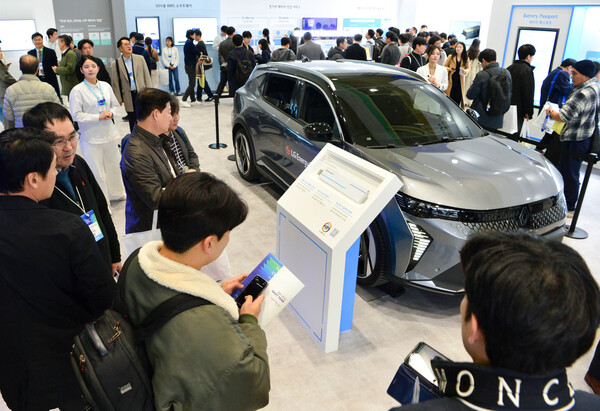
InterBattery 2026 opened with a record turnout of 667 companies from 14 countries. Uhm Gi-cheon (엄기천), CEO of POSCO Future M, said, "In the past, the three together had more than 50 percent global market share, but now it is only 17 to 18 percent." He delivered the remarks as head of the Korea Battery Industry Association, conveying both a sense of crisis and responsibility.
The international battery exhibition InterBattery 2026 runs from March 11 to March 13 at COEX in Seoul. A total of 667 companies from 14 countries filled 2,382 booths, including about 180 foreign exhibitors. Visitor numbers have risen for three straight years, from 61,787 in 2023 to 70,508 in 2024 and 77,102 in 2025.
This year, a sense of crisis surfaced across the booths. Lee Cheol-gyu (이철규), chairman of the National Assembly's Trade, Industry, Energy, SMEs and Startups Committee, said after a booth tour, "Without overwhelming technological superiority, it will be difficult to compete on the global stage in terms of price competitiveness." The high-nickel segment said a gap still remains in quality stability, but its own assessment was that roadmaps and performance levels have become almost the same as China's, with differences in product-to-product variation and quality stability. Uhm also said supply-chain problems and protectionism are emerging as a crisis for K-batteries.
The situation has been compounded by falling utilisation rates at domestic battery and materials companies due to the North American electric-vehicle chasm. LG Energy Solution's factory utilisation rate fell below 50 percent for the first time last year. According to its annual report filed on March 12, average utilisation of its production facilities last year was 47.6 percent. That was down by more than 10 percentage points from 2024, when it recorded 57.8 percent. It has declined for three consecutive years since 2023.
The mood at the venue was not entirely downbeat. Speakers acknowledged the crisis but also outlined potential turnaround cards. Uhm said the K-battery ecosystem could overcome the crisis by acting as one team. He also said it must move back ahead of China with solid-state or next-generation batteries, and that the association would draw up practical strategies with companies and the government.
Materials, parts and equipment companies including Samsung SDI, LG Energy Solution and POSCO Future M also presented their own cards. Concrete strategies for a "next step after China" took shape at the venue.
◆ Solid-state, new markets, LFP... K-battery's cards to turn the tables on China
This year's key agenda is energy storage systems (ESS). With electric-vehicle demand slowing, fast-growing ESS driven by expanding renewable energy and AI-transition demand has emerged as an alternative. Strategies to respond to changes in the trade environment, including U.S. tariff policy and EU battery rules, were also discussed, and a co-prosperity procurement consultation event involving purchasing managers from the three battery makers was operated.
The first turnaround card is solid-state batteries. LG Energy Solution displayed a physical sulfide-based solid-state battery cell for the first time and presented a commercialisation roadmap targeting 2029 for graphite-based cells for electric vehicles and 2030 for anodeless cells for robots and urban air mobility (UAM). Samsung SDI also unveiled for the first time a sample of a pouch-type solid-state battery for physical AI. POSCO Future M said it plans to supply cathode materials to Factorial, in which it has invested, for installation in European and U.S. OEM supercars in 2 years. Uhm said, "Solid-state is the next-generation battery that can allow K-batteries to overtake China."
At the exhibition, visitors could directly check products from the three battery makers. LG Energy Solution, under the message of "high energy density and fast charging that go beyond the limits of lithium-ion batteries (LIB)," displayed for the first time a physical sulfide-based solid-state battery cell and a mock-up module. At robotics-related booths, it also revealed solid-state cells applicable to service robots, humanoids and industrial robots.
Samsung SDI showcased its solid-state battery sample for physical AI alongside an LMO prismatic battery used in uninterruptible power supply (UPS) systems for AI data centres and a 700Wh/L high-energy prismatic battery that won this year's InterBattery Awards.
SK On unveiled a prismatic "on-vent cell" that can vent gas and heat in a desired direction at the structural design stage, winning an award. Two immersion-cooling battery pack types being jointly developed by SK On and SK Enmove were also displayed. It also showcased 4 pack solutions, including a pouch-integrated prismatic pack that combines design flexibility and structural strength by housing pouch cells in an aluminium case.
Another card is growth markets such as robots and UAM. Choi Moon-ho (최문호), CEO of EcoPro BM, said, "For applications with lots of outdoor activity such as UAM or humanoids, energy density can be more important than price." He said solid-state batteries, with high safety, can reduce firefighting equipment, making them suitable for robots in terms of weight and volume.
POSCO Future M said it is jointly developing batteries for drones and humanoids with Factorial, and is also working on humanoid battery development with a separate customer. The target is commercialisation in 2028. Samsung SDI plans to complete preparations for mass production of solid-state batteries by next year and take the lead in the global robot market. Samsung SDI unveiled its solid-state battery, "SolidStack," for the first time at the exhibition.
Hyun Jang-seok (현장석), an executive director in Samsung SDI's strategy marketing office, said at the Battery Conference side event held on March 12, "Solid-state batteries will be the ultimate game changer in the era of humanoid robots." He said it is an innovative solution that guarantees absolute safety while being light with high capacity, extending robot operating time to 8 hours.
The final card is entering LFP cathode materials. Uhm said, "We have agreed to complete the conversion of the existing ternary line in July to August, go through certification in the third quarter and provide mass-produced products to domestic customers by the end of the year." Expectations also emerged that competitiveness could recover for K-battery materials companies that already have local production bases, as the EU's Industrial Acceleration Act (IAA) takes effect and strengthens a trend toward higher battery self-sufficiency within the region. The Hungary plant is also operating as planned.
The key is cost competitiveness. For solid-state battery costs in particular, lithium sulfide, a key raw material, can be made cheaper as production scale grows. The cost of air-handling facilities will also fall when moving to mass-scale production. That means expanding the scale of materials supply and process innovation must support the three cards for them to work properly. How persuasive a roadmap K-batteries presented at this InterBattery is expected to be the starting point for order competition in the second half of this year.
 Daegeon Seok
d2dg@d-today.co.kr
Daegeon Seok
d2dg@d-today.co.kr