
Naver and Kakao have each shut down ClovaX·Cue and KakaoTV. On the surface, the moves look like business cutbacks. A closer look points to a shift toward reinforcing core businesses. Instead of continuing individual service experiments, the companies have moved AI and content capabilities into their core platforms. Naver is focusing on search and shopping, while Kakao is centring on KakaoTalk.
◆ Focusing capabilities on core platforms after ending standalone services
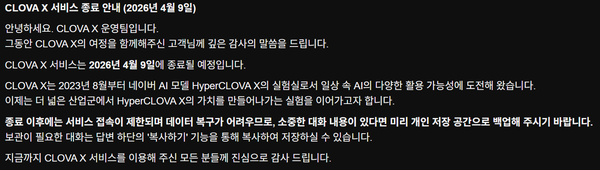
According to the industry on March 12, Naver will end its conversational AI service ClovaX and its generative AI search service Cue on April 9. ClovaX was launched as a service positioned as a rival to ChatGPT, based on Naver’s own large language model (LLM), HyperCLOVA X. Cue has been testing vertical search that links search to reservations and purchases.
Naver describes the shutdown as a process of integration into its formal service system rather than a failure of AI experimentation. It says ClovaX and Cue served as a laboratory for HyperCLOVA X and that it is now moving to a stage of deploying results into its main services. The industry reads it differently. It is seen as shifting weight from competing as a standalone AI platform emphasising model performance to embedding AI into search and shopping, where user contact is already large, to raise the potential for practical use and monetisation.
Kakao’s decision is read in the same context. Kakao will end KakaoTV, which it has operated for about 9 years, on June 30. It started as Daum TVpot and aimed to be a comprehensive video platform spanning live broadcasts, original content and VOD. Its influence gradually weakened amid an offensive by global platforms such as YouTube and Netflix and the rise of domestic competing platforms.
This marks the end of a step-by-step downsizing that included halting revenue sharing for donations and advertising in 2021, ending paid original businesses in 2023 and ending app services in 2024. Kakao cited business efficiency and mid- to long-term competitiveness as reasons for the shutdown. Without securing a differentiated user base or killer content as a standalone video platform, a strategy of providing broad content evenly was structurally disadvantaged in competition with global platforms such as YouTube.
Kakao Games also decided to halt PC game channelling services it has operated through the Daum platform. The services include Lost Saga, Final Fantasy XIV and Audition. The industry sees Kakao stepping up efforts to streamline businesses with low usage or small scale after it signed an agreement to acquire Daum with AI startup Upstage. It is seen as accelerating moves to scale down services that started on Daum and to reorganise its core platform around KakaoTalk.
◆ Both companies put AI at the forefront; competition likely to hinge on monetisation models
Naver’s next steps are relatively specific. Generative AI search technology accumulated through Cue has already been internalised as “AI Briefing” and is being provided to all search users. It plans to launch “AI Tab” in the first half of this year, enhancing conversational search functions. In commerce, it has also introduced a beta version of a “shopping AI agent” and is focusing on raising purchase conversion rates. When users search for products, the AI summarises information and makes recommendations.
Naver’s policy is to focus capabilities on creating an environment where all users can enjoy tangible benefits by embedding AI across its services, including search and shopping. It is moving the vertical search experience verified in Cue to AI Briefing and AI Tab, and linking that to improvements in search and commerce conversion rates.
Kakao’s direction is also clear. Ending KakaoTV is not a simple withdrawal but largely a repositioning aligned with changes in video consumption. Kakao already placed a short-form service in a “third tab” next to the friends list and chat tab through a KakaoTalk interface overhaul in September last year. Instead of a long-form standalone video platform, it chose a structure that naturally connects short video consumption within KakaoTalk, a major traffic hub. Kakao said it plans to expand participating creators and strengthen its support and reward system to grow the short-form ecosystem.
Kakao will also advance AI monetisation inside KakaoTalk. “ChatGPT for Kakao,” launched last year in collaboration with OpenAI, has secured 8 million users, and this year it will begin on-device AI collaboration with Google. Its lightweight in-house AI model, “Kanana in KakaoTalk,” is the starting point. That is, Kakao is shifting its centre of gravity to combining both video consumption and AI services within KakaoTalk rather than on separate platforms. Jong-won Lee (이종원), an analyst at BNK Investment & Securities, said, “Future earnings contributions through AI will become visible when a partner ecosystem is sufficiently secured and meaningful transaction volume flows into KakaoTalk.”
The two companies’ strategies are converging in the same direction. Naver is turning AI into standard functions for search and shopping, while Kakao is concentrating the centre of its video and AI strategy on KakaoTalk.
This can also be read as a realistic choice to raise practical use and monetisation within platforms where each company has strength, rather than competing head-on with global big tech in general-purpose AI platforms or standalone content services. In the end, the key to the shutdown is less about what was folded than what is being refocused on. Efficiency over expansion, and strengthening core businesses over broadening reach, are the next steps shared by both companies.
An industry official said, “It appears both Naver and Kakao have decided the stage of opening new markets through standalone services is over.” The official added, “From now on, how quickly they can build monetisation models on the platforms where the most users gather will be the standard that separates the competitiveness of the two companies.”
 Ho-jung Lee
lhj@d-today.co.kr
Ho-jung Lee
lhj@d-today.co.kr