
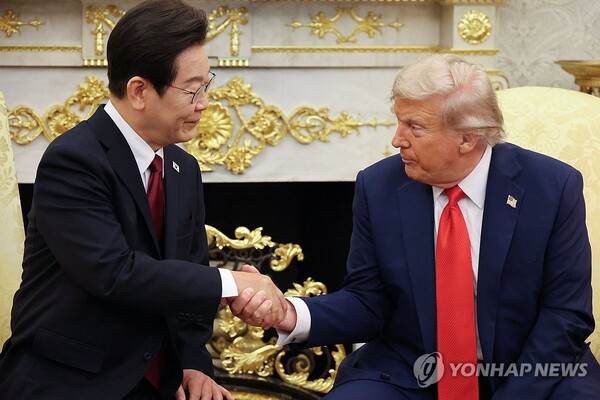
A legal foundation has been laid for implementing South Korea-U.S. investment commitments. The National Assembly passed the Special Act on the Operation and Management of Strategic Investment between the Republic of Korea and the United States, by bipartisan agreement, at a plenary session on March 12. It comes about 4 months after the two countries signed an MOU on strategic investment worth a total of $350 billion on Nov. 14 last year, and 106 days after the bill was introduced.
The legislation is rooted in trade pressure from the United States. Processing accelerated after President Trump in January signalled a plan to raise tariffs again, citing the failure to pass the special act. On the same day, the Office of the U.S. Trade Representative launched an overcapacity investigation under Section 301 of the Trade Act targeting 16 trading partners, including South Korea.
The special act sets out an implementation framework and ways to raise funds to carry out the MOU. Of the total, $200 billion will be invested in strategic industries including shipbuilding, semiconductors, pharmaceuticals, critical minerals, energy and artificial intelligence. Another $150 billion will be allocated to shipbuilding cooperation investment, including private investment in the shipbuilding sector and ship finance. The law sets an annual cap of $20 billion for investment in the United States and states a principle of ensuring commercial rationality.
As the implementing entity, the Korea-U.S. Strategic Investment Corp will be created. The government will fund it entirely, and its statutory capital will be 2 trillion won. The corporation will be dissolved after operating for a limited period of up to 20 years. A Korea-U.S. Strategic Investment Fund will be established under the corporation, and the fund will be financed through the corporation’s contributions, foreign currency assets entrusted by the Bank of Korea and the Foreign Exchange Stabilization Fund, and issuance of overseas government-guaranteed bonds.
Decision-making was designed as a two-tier structure. A project management committee to be set up at the Ministry of Trade, Industry and Energy will review the commercial rationality of candidate projects. An operating committee, chaired by the deputy prime minister who also serves as finance and economy minister, will conduct final deliberation and approval. Even when commercial rationality is not secured, the law provides an exception allowing projects to proceed if there are unavoidable reasons such as national security and supply chain stability, on condition of prior consent from the relevant standing committee of the National Assembly.
The government plans to launch an establishment committee immediately upon promulgation of the special act. It plans to complete the setup of the corporation and fund and prepare subordinate regulations by the law’s effective date, 3 months after promulgation. Written opinions from interested parties can be submitted until April 15, and public hearings will begin on May 5.
Separately, the industry ministry said it will expand the support limit for small and medium-sized companies and mid-sized companies responding to import regulations from 30 million won to 60 million won and abolish out-of-pocket payments entirely, in line with the launch of the Section 301 probe. Applications for the revamped programme can be submitted from March 13.
Deputy Prime Minister Koo Yun-cheol (구윤철), who also serves as finance minister, said, "As external uncertainties such as global supply chains, tariffs and the trade environment expand, handling this special act will help ease some of the uncertainties for our companies."
 Seok Dae-geon
d2dg@d-today.co.kr
Seok Dae-geon
d2dg@d-today.co.kr