
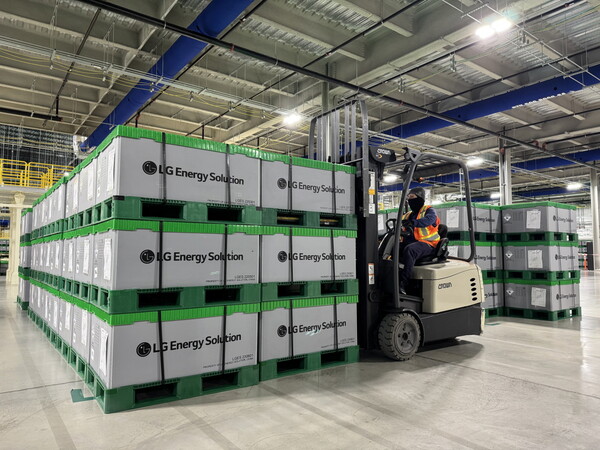
[Digital Today reporter Daegeon Seok] South Korea’s three main battery makers are seeking a turnaround this year with energy storage systems (ESS) at the forefront. Each is expanding the business to a scale comparable to its electric-vehicle operations, accelerating a shift toward an ESS-centred structure. The model in which ESS offsets weak EV demand is expected to take hold in earnest from this year.
The K-battery big three’s ESS business is set to grow this year to a scale that offsets weak EV demand. According to Mirae Asset Securities, LG Energy Solution’s estimated ESS division revenue alone is 10.2 trillion won this year, expected to rise 233 percent from last year. Samsung SDI has confirmed large-scale orders from the world’s top operator, and SK On is stepping up its market entry with line conversions and safety technology.
ESS has emerged as a driver of earnings as power demand at AI data centres rises more than before. According to Eugene Investment & Securities, approvals for grid connections have stretched to up to 4 years or longer as U.S. AI data centres expand, making ESS essential infrastructure to buffer grid constraints. BloombergNEF (BNEF) projects U.S. ESS demand in 2026 to 2030 at 64 to 113 GWh, but a compilation of battery makers’ market outlooks puts it at 80 to 150 GWh, above existing projections.
LG Energy Solution is moving fastest. According to Mirae Asset Securities, ESS will account for 36 percent of revenue this year, similar to EV division revenue of 10.4 trillion won. LG Energy Solution says its cumulative order backlog is 140 GWh, and its target for new orders this year is at least 90 GWh, last year’s record high. It aims to more than triple ESS revenue from last year.
Orders have continued from the start of the year. LG Energy Solution last month signed an additional supply contract of 5 GWh with Hanwha Qcells' U.S. unit for 2028 to 2030. Last year it signed successive deals with U.S. firms including Teragen (8 GWh), Excelsior Energy Capital (7.5 GWh), Delta Electronics (4 GWh) and EG4 Electronics (13.3 GWh). In March this year it also concluded a 1 GWh deal with Poland’s state-owned power company PGE. It is also expanding its North American production base. Its Holland, Michigan plant began operating in June last year, and its Lansing, Michigan plant and an Ohio joint-venture plant will begin additional operations within this year. Its global ESS production capacity is 60 GWh, of which North America accounts for 50 GWh.
LG Energy Solution Chief Executive Dong-myung Kim (김동명) said in a message to employees in February this year, "The situation we face is a value-shift process in which the growth value of the industry is being reshaped." He added, "In the North American region, LG Energy Solution is effectively the only company that has both production facilities and SI-based turnkey solution capabilities," signalling business expansion this year.
On its fourth-quarter earnings conference call, the company also said, "2026 is the time when structural changes become a reality, with a slowdown in EV market growth and a rise in ESS demand." It said it would focus on accelerating growth in its ESS business and strengthening the qualitative competitiveness of its EV business, emphasising its plans for this year.
KEY ISSUE IS EV FIXED-COST BURDEN AND TARIFF UNCERTAINTY
Samsung SDI has also reached a turning point. Mirae Asset Securities estimates that ESS orders from the world’s top operator have been confirmed. The order is for at least 30 GWh over 3 years, 10 GWh a year, of prismatic lithium iron phosphate (LFP) batteries. Mirae Asset Securities raised its target share price to 500,000 won from 450,000 won, and IBK Investment & Securities raised its target to 410,000 won. According to IBK Investment & Securities, 3 of 4 lines at its North American base SPE, with a capacity of 33 GWh, will be converted to ESS, lifting North American ESS production capacity to 29 GWh by the end of this year.
SK On is shoring up its market entry base as it wraps up restructuring. The company in December last year dissolved BlueOval SK, its joint venture with Ford, and decided to operate its Tennessee plant with a capacity of 45 GWh on its own. It is accelerating changes to enable ESS supply as well as EVs. It will build an ESS battery production line with annual capacity of 3 GWh by converting lines at its Seosan plant in South Chungcheong province this year, and it will apply the industry’s first fire early-detection technology based on electrochemical impedance spectroscopy (EIS).
The remaining question is whether expanding ESS revenue can actually offset weak EV demand. Mirae Asset Securities analysed that the company has "entered a meaningful earnings expansion phase with ESS alone" and that earnings gains from ESS results will continue through 2027, given that concerns over North American EVs have been sufficiently priced in. Still, fixed-cost burdens from lower utilisation rates at North American EV lines and tariff uncertainty are variables. An industry official said this year’s K-battery results depend on how quickly the ESS shift can make up for EV losses.
 Daegeon Seok
d2dg@d-today.co.kr
Daegeon Seok
d2dg@d-today.co.kr