
NCSoft is moving to break away from a business structure centered on massively multiplayer online role-playing games, or MMORPGs, and build a predictable growth model. It presented a blueprint to open an era of 5 trillion won in revenue by 2030 by securing cash with existing intellectual property such as Lineage and diversifying its lineup into shooting, subculture and action RPG titles and mobile casual games.
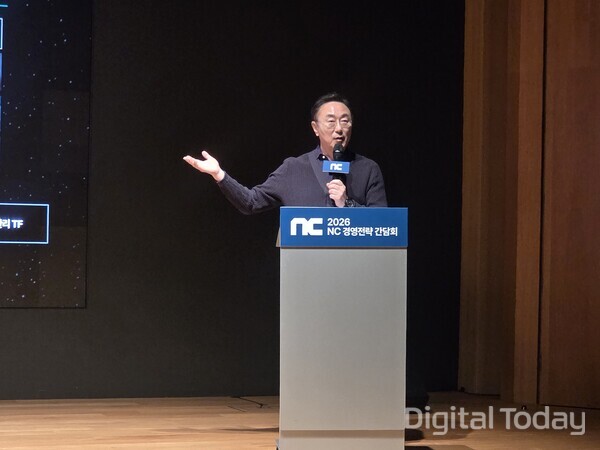
NCSoft disclosed the plan on March 12 at its "2026 management strategy briefing" at the Pangyo R&D Center.
Co-CEO Byung-moo Park (박병무) directly pointed out NCSoft's structural problems at the time of his appointment. The heavy bias toward MMORPGs meant results and the stock price swung sharply depending on the success or failure of 1 or 2 games. About 70 percent of revenue was concentrated in 3 regions: South Korea, Taiwan and Japan. The core customer base also skewed toward ageing Lineage users. Repeated cases also occurred in which launches were delayed because development autonomy was too large, causing the company to miss market trends.
Park said the past 2 years were a time to lay the groundwork for future growth and that the company will move into a full-fledged growth shift from this year.
◆Protect legacy IP and expand with new IP
NCSoft's growth strategy consists of 3 pillars.
First is upgrading legacy IP. It will improve operating systems for major existing IP such as Lineage, Aion, Guild Wars 2 and Blade & Soul, expand service regions and continue spin-off new releases. Park said this pillar would keep stable cash flow of around 1.5 trillion won a year in the future as well.
It is also expanding new IP. It plans to build a lineup by 2029 of more than 10 internally developed titles and more than 6 published titles, and it has broadened genres to include shooting, subculture and action RPG. The already unveiled "Time Takers" will start a closed beta test on March 14, and "Limit Zero Breakers" and "Cinder City" are also preparing tests. "Defect," developed by a U.S. studio, will be published by NC America, and an investment in a Japanese subculture studio is in the final stages.
NCSoft also changed how it develops games. It has been operating a gameplay evaluation committee, a technical evaluation committee and a progress-management task force since 2025 to manage quality and schedules together. Park said it decides whether to move to the next stage based on test results and metrics, not intuition or internal tastes. He said the company will not deny the possibility of failures in new titles but will shift to a structure that raises the success rate by accumulating the reasons for failures and successes.
◆Why mobile casual, and why now
The third pillar is mobile casual, the part given the most weight at the briefing.
According to Ahnell Cheaman (아넬 체만), head of the mobile casual center, mobile accounts for half of the roughly $190 billion global games market, and the casual and hybrid casual segment is worth $57 billion and has been growing for 3 straight years. Park said domestic game companies have paid relatively less attention to this market, but he judged that major global game companies are already investing aggressively.
NCSoft said its own capabilities also influenced its choice of the market. Mobile casual is an area where data analysis, user acquisition, advertising efficiency analysis and live operations capabilities matter more than blockbuster IP. The company said NCSoft's capabilities built over 30 years of operating large-scale MMORPGs align with that. Park said what it lacks is direct execution experience in mobile casual, and to complement that the company recruited Cheaman in July last year, who has more than 10 years of experience in the field.
NCSoft will run its mobile casual business through 5 stages: concept testing, short-term prototype production, real-user A/B testing, a metrics-based decision on whether to launch, and live operations. The core is a structure that repeatedly verifies in small units and then grows only projects with confirmed performance. Cheaman said it is a model with high predictability in which data-driven decision-making is made at every stage.
To support this ecosystem, it has secured studios including Germany's JustPlay, Vietnam's RiHooHoo, South Korea's SpringComz and Slovenia's MovingEye. All studios are connected to headquarters' central data platform to share user acquisition, advertising efficiency analysis, live operations and AI functions. Park said many existing mobile casual success cases often stayed within a single studio, adding that NCSoft will first build a structure that generates synergies by tying multiple studios together with a platform and data system.
Asked whether MMORPG operating experience also works for mobile casual, Cheaman said the nature of content is different but the principles are the same on what events and rewards to present to users and when, and how to raise long-term retention. He cited declining long-term retention as the biggest problem in the mobile casual market and said NCSoft's experience and technology from operating Lineage since 1998 becomes competitiveness here.
On profitability, CFO Won-jun Hong (홍원준) said the 2 key costs in mobile casual are user acquisition and distribution fees. He said spending can be executed strategically based on return on ad spend standards, and considering the introduction of its own payments and higher efficiency in live operations, it is not a low-profit business. He said an average operating profit margin in the mid-15 percent range is possible under the current structure, and that about 20 percent could be possible in a stabilization phase.
NCSoft said it will achieve 2.5 trillion won in revenue and a meaningful operating profit this year, then achieve 5 trillion won in revenue and a return on equity of at least 15 percent by 2030. It said it has set an internal target structure in which legacy IP supports the downside at about 1.5 trillion won a year, new IP drives additional growth, and mobile casual accounts for around 35 percent of total revenue.
Park said the people who pay employees' salaries are not the boss but customers, stressing the need to restore user trust. "Users should spend money because they like it," he said. "If users become dissatisfied and are forced to spend, it ultimately becomes exhausted."
 Hojeong Lee
lhj@d-today.co.kr
Hojeong Lee
lhj@d-today.co.kr