
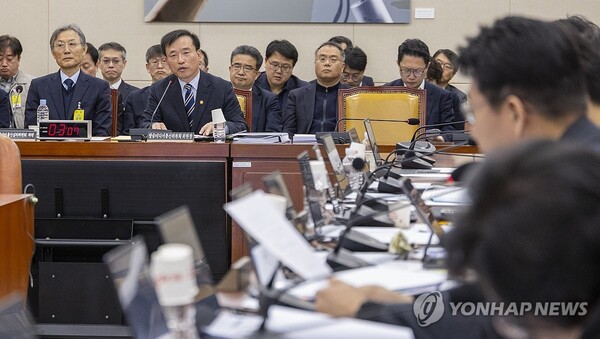
South Korea's Broadcast Media Telecommunications Commission on Feb. 10 held its first work briefing at a plenary meeting of the National Assembly's Science, ICT, Broadcasting and Communications Committee. It came about 2 months after Kim Jong-cheol (김종철), the first chair, was appointed on Dec. 18 last year.
The briefing focused on key issues including relicensing of broadcasters, controversy over alleged infringement of universal viewing rights and enactment of an integrated media law. Lawmakers also held discussions on Grok AI deepfakes, teenagers' overdependence on social media and preparations to enforce the Information and Communications Network Act.
Re-licensing is most urgent - task of reflecting changes in the media environment
Asked by Democratic Party lawmaker Cho In-chul (조인철) about relicensing of broadcasters, Kim said the process was currently being delayed and some cases were already past their deadlines. He said it was a representative item the commission must handle as a top priority once its members are appointed.
Under the Broadcasting Act, terrestrial broadcasters must obtain relicensing before their licence validity period expires within 5 years. But 12 terrestrial broadcasters including KBS 1TV, MBC and EBS saw their licences expire on Dec. 31, 2024, while 4 community radio operators, 8 operators including DMB and 1 general programming channel saw their licence or approval periods expire in 2025. Relicensing reviews did not proceed due to disruption at the Korea Communications Commission, the predecessor of the Broadcast Media Telecommunications Commission.
Cho noted that Britain's BBC was also said to be stopping terrestrial broadcasting and said serious consideration was needed on how to handle terrestrial broadcasting amid changes in the media environment. Kim said working-level preparations were under way to reflect changes in the future environment.
Grok AI deepfakes, women's auction broadcasts - urgent need to protect teenagers
Democratic Party lawmaker Lee Ju-hee (이주희) said illegal information involving sexual exploitation and human rights violations was being indiscriminately distributed on global platforms such as YouTube and X, formerly Twitter.
Lee said broadcasts were openly thriving that show women's faces and say, "The real person is prettier. 150,000 won winning bid," while selling contact details and "date vouchers". She said X real-time trends were exposing prostitution slang such as "conditional meeting" and "private transfer" among top-ranked terms.
She also cited an incident that sparked worldwide controversy in which X's AI chatbot Grok generated deepfake sexual exploitation material indiscriminately, targeting not only female celebrities but also ordinary people and children and teenagers. Lee said a maximum fine of up to 10 million won was far from sufficient and asked the commission to actively cooperate as she seeks to pursue a digital safety law for children and teenagers.
Kim said he agreed with the purpose of the legislation and expressed willingness to cooperate.
The commission in January asked X to take youth protection measures related to the Grok service. It notified X to draw up specific protection plans including restricting youth access and management measures, and clearly conveyed that in South Korea the making, distribution, possession and viewing of false sexual videos against a person's will are subject to criminal punishment.
Reality of not being able to watch the Winter Olympics and pro baseball - infringement of universal viewing rights
People Power Party lawmaker Shin Sung-bum (신성범) raised the issue of infringement of universal viewing rights due to JTBC's exclusive broadcast of the Milan Winter Olympics.
Shin said elderly people in the regions do not know which channel number to watch the Winter Olympics on. He said professional baseball was in an era of 12 million spectators but does not appear at home and people have to install an OTT app, sign up for membership and pay. He criticised that when rights fees are bought at high prices, terrestrial broadcasters do not buy them because they cannot attract advertising, and the burden is ultimately shifted entirely to the public.
Shin again asked whether the universal viewing rights review was carried out under Article 76 of the Broadcasting Act and whether JTBC provided it at a fair and reasonable price. Kim said it could not be compelled under the law but the commission was exploring various measures such as having it jointly broadcast with terrestrial broadcasters. He acknowledged there had been an administrative vacuum in broadcasting amid rapidly changing media conditions.
Integrated media law discussed for 15 years - urgent need to remove barriers among ministries
Democratic Party lawmaker Lee Hoon-ki (이훈기) stressed the need to enact an integrated media law, formally the Audiovisual Media Services Act. Media administration is currently split among the commission, which handles terrestrial and pay TV, the Ministry of Science and ICT, which handles OTT and other online platforms, and the Ministry of Culture, Sports and Tourism, which promotes content.
Lee said either duties among ministries must be reassigned or integrated, and said coordination was not working. The integrated media law has been discussed for more than 15 years but has still not been enacted. Committee Chair Choi Min-hee (최민희) published a draft in early January, giving the discussions momentum.
Kim said a policy consultative body among ministries was being operated and the commission was considering the early formation of a Media Development Committee under the prime minister. He said he would actively cooperate in enacting the law by communicating with relevant ministries.
Measures for teenagers' overdependence on social media and telecoms network law revision also on agenda
Cho said the process was out of order in drawing up measures to respond to teenagers' overdependence on social media.
Cho said it asked to draw up a draft after hearing opinions from a special committee on teenagers and questioned whether that order was correct. He said it would be right to draw up a draft more broadly for the whole public first and then hear teenagers' views.
Kim said he would gather opinions not only from the special committee on teenagers but also from experts, teachers and parents. He said the commission would hear views from various stakeholders from the draft preparation stage.
People Power Party lawmaker Choi Su-jin (최수진) pointed to the recently passed amendment to the Information and Communications Network Act, saying the International Federation of Journalists had also expressed concern that it could affect freedom of expression and press freedom. She said some diplomatic and trade channels had raised concern it could affect international technology cooperation and asked what consultations were under way with global platform companies. She said provisions on false information were vague and the definition of the public interest was unclear.
Kim said follow-up regulations were being prepared in line with constitutional principles and international standards. He said the aim was to issue a legislative notice in March and seek Cabinet approval before the enforcement date of July 7.
Separately, the National Assembly will vote on members of the commission at a plenary session on Feb. 12. The commission currently operates with two members: Chair Kim, appointed by the president, and Ryu Shin-hwan (류신환), a non-standing member. If the National Assembly approves five members recommended by parliament, two from the ruling party and three from the opposition, it will meet the requirement to convene meetings with at least four registered members. People Power Party floor spokesman Choi Hyung-doo (최형두) said the opposition's committee for recommending public officeholders was in the final verification stage and he thought approval would come on the 12th.
 Seulgi Son
sageson@d-today.co.kr
Seulgi Son
sageson@d-today.co.kr