
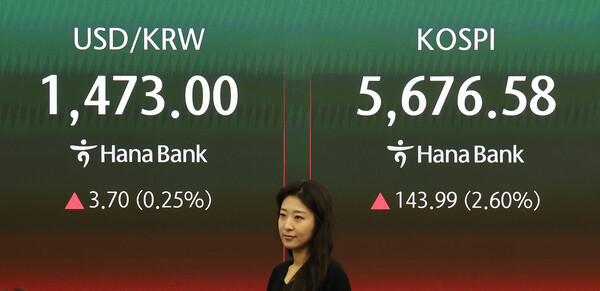
As instability in the Middle East grows, volatility in the foreign exchange market is increasing, with the won-dollar exchange rate moving above the 1,470 won level. The market is also discussing the possibility that the rate could rise into the 1,500 won range if the situation worsens. Tension is also rising in the banking sector because a prolonged uptrend in the exchange rate could affect capital adequacy indicators in the financial sector.
The won-dollar exchange rate opened at 1,474.0 won in the Seoul foreign exchange market on March 11, up 4.8 won from the previous session, reflecting overnight dollar strength and offshore trading flows. It later swung between gains and losses and closed down 2.7 won at 1,466.5 won.
In a report on the day, Min-hyuk Lee (이민혁), an economist at KB Kookmin Bank, forecast that the won-dollar exchange rate was likely to move in the 1,469 to 1,480 won range. In the offshore non-deliverable forward (NDF) market, the 1-month contract traded at 1,471.90 won, up 4.05 won from the previous day.
◆ Upward pressure on the exchange rate as Middle East risks grow
Geopolitical tensions in the Middle East are cited as the backdrop to the exchange rate rise. In particular, as conflict between the United States and Iran over the Strait of Hormuz intensifies, risk-off sentiment in global financial markets is spreading.
Lee said uncertainty over the Strait of Hormuz was limiting any rebound in the won’s value. He said the Seoul foreign exchange market was reacting sensitively to international oil prices and the flow of Middle East-related news.
International oil prices have also been swinging sharply, adding to market volatility. Prices fluctuated sharply after the U.S. energy secretary posted and then deleted a message saying escorts of oil tankers passing through the Strait of Hormuz had succeeded, and the White House denied it. West Texas Intermediate (WTI) fell to $76 a barrel during the session before rebounding above $80.
Tension also rose on news Iran had installed mines and after hardline remarks by U.S. President Donald Trump. Trump warned there would be "unprecedented military consequences" if the mines were not removed. The dollar index, which measures the dollar’s value against six major currencies, rose 0.19 percent from the previous day to 98.93.
Some in the market say upward pressure on the exchange rate is dominant in the short term. Lee said downside in the exchange rate was limited amid tension and caution, while the upside was dominant. He said short-term resistance could form around the 1,480 won level.
Still, there is also a view that the exchange rate could fall to the pre-war level in the 1,430 won range if the Middle East situation stabilises quickly and international oil prices settle.
◆ Financial sector moves to respond to exchange rate risks
This rise in the exchange rate could also act as a variable in capital adequacy management in the financial sector. That is because it could act as downward pressure on the common equity tier 1 (CET1) ratio, a key capital adequacy indicator for financial holding companies.
The CET1 ratio is calculated as common equity capital divided by risk-weighted assets (RWA), and is a key indicator of a financial company’s capital soundness. When the exchange rate rises, the won value of foreign currency loans increases, expanding risk-weighted assets, which can push down the CET1 ratio.
Major domestic financial holding companies’ CET1 ratios stood at 12.25 to 13.79 percent as of the end of last year, all above the 12 percent level recommended by financial authorities. KB Financial was at 13.79 percent, Hana Financial at 13.37 percent, Shinhan Financial at 13.33 percent, Woori Financial at 12.9 percent and NH NongHyup Financial at 12.25 percent. Financial holding companies are also setting a goal of managing CET1 ratios at 13 percent or higher to expand shareholder returns.
As the recent rise in the exchange rate continues, major financial groups are strengthening their response systems, including holding response meetings chaired by group chairmen or bank presidents and conducting risk checks.
KB Financial, which has the highest CET1 ratio, is strengthening its currency hedging strategy to minimise fluctuations in foreign exchange translation gains and losses excluding investment profit and loss. It said it was managing the group’s foreign exchange exposure by considering foreign exchange positions by affiliate. KB Kookmin Bank is also strengthening management of capital adequacy indicators such as the CET1 ratio and the Bank for International Settlements (BIS) capital ratio. It said it was systematically managing capital efficiency by introducing the return on risk-weighted assets (RORWA) indicator.
Shinhan Bank plans to check the situation in real time and, if unusual trends emerge, convene either a crisis management consultative body chaired by the chief risk officer (CRO) or a crisis management committee chaired by the bank president.
Hana Bank has established and is operating a 'macroeconomic indicator monitoring system'. Woori Bank has also prepared 'response measures by exchange rate level' and is managing them so it can immediately activate an emergency response system depending on market conditions.
Short-term foreign currency liquidity is assessed as relatively stable. Commercial banks’ foreign currency liquidity coverage ratios (LCR) are managed at 140 percent or higher, far above the 80 percent regulatory standard set by financial authorities. The foreign currency LCR is the ratio of high-quality liquid foreign currency assets held to expected net foreign currency outflows over the next 30 days, and indicates a financial firm’s ability to respond to short-term foreign currency liquidity needs.
A banking sector official said the recent rise in the exchange rate was largely due to a combination of geopolitical risks and a strong global dollar. The official said banks were closely checking key soundness indicators such as foreign currency liquidity and capital ratios in preparation for a possible expansion in exchange rate volatility.
Another financial holding company official said a rise in the exchange rate was not at a level that would directly shock financial firms’ soundness in the short term, but if the size of the rise grows, it could increase risk-weighted assets and burden CET1 ratios. The official said the group was responding to volatility through currency hedging and foreign exchange position management.
 Ji-young Lee
ljy@d-today.co.kr
Ji-young Lee
ljy@d-today.co.kr