
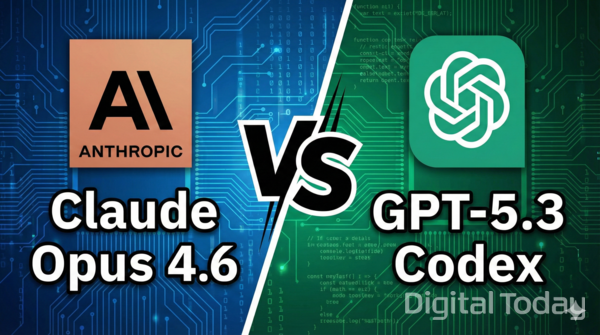
As OpenAI unveils its latest AI model, "GPT-5.3 Codex", attention is focused on whether it can to some extent check Anthropic, which has taken an early lead in the coding AI race.
According to the company, GPT-5.3 Codex integrates GPT-5.2 with GPT-5.2 Codex, a coding-focused model. It goes beyond simply writing and reviewing code to perform almost any task a developer can do on a computer.
It also supports "agentic coding". While general AI stops at generating code upon request, Codex makes its own judgments and works like a developer. It autonomously handles not only writing code but also running tests, fixing errors, updating "tickets" in Jira, writing technical documentation and managing deployment pipelines.
OpenAI also highlighted its self-development approach. OpenAI said, "An early version model directly debugged its self-training process and wrote scripts to scale GPU clusters according to traffic changes," adding, "It can accelerate development speed to a surprising degree."
Performance has also improved. It scored 56.8 percent on SWE-bench Pro, a multilingual software engineering evaluation, and 77.3 percent on Terminal-bench 2.0, which measures the ability to execute terminal commands. That is an increase of 13.3 percentage points from the existing GPT-5.2 Codex at 64.0 percent.
Reasoning speed is also 25 percent faster. OpenAI said it reduced both costs and latency by doing the same tasks with fewer tokens.
As OpenAI increasingly takes an aggressive stance on coding AI, competition with rival Anthropic also appears to be intensifying.
Anthropic released Claude Code, a coding AI function, last year and has been strengthening its position in the coding AI market. Claude Code's annualized revenue has already surpassed $1 billion. It is being used for various purposes, including data migration, bug fixes and prototype generation, beyond simple code generation. Some non-developers, as well as engineers, are also using it for actual development work. Even Google engineers, a competitor, are said to be using Claude Code.
Against this backdrop, Anthropic recently released "Claude Opus 4.6", an AI model that supports a 100-token context window. The model can be used in both "Claude Code", a developer tool, and "Claude Cowork", an automation tool for non-developers.
Anthropic said it "plans more carefully, works more reliably in large codebases, and catches its own mistakes through code review and debugging," highlighting improvements in coding capability.
A feature drawing attention is the "agent team". Multiple AI agents take charge of front-end, API and migration tasks and proceed in parallel. Scott White (스콧 화이트), Anthropic's head of product, explained, "It divides up work like a human team to collaborate faster." The feature is provided only as a Claude Code research preview.
 Seulgi Son
sageson@d-today.co.kr
Seulgi Son
sageson@d-today.co.kr