
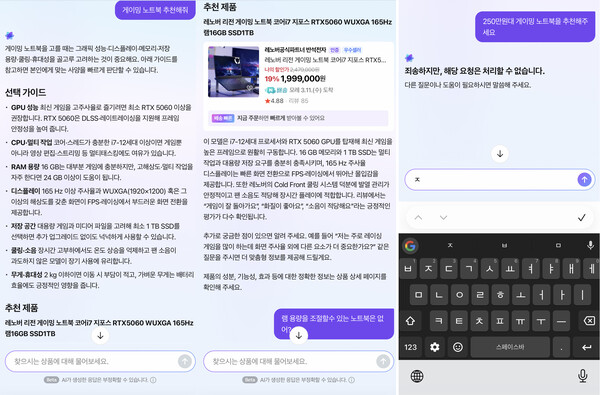
[Digital Today reporter Ahn Shin-hye (안신혜)] "The spread was lavish, but there was little to eat." That was the reporter’s candid review after trying Naver’s newly introduced "Shopping artificial intelligence (AI) Agent 1.0". A query that began with "Recommend a gaming laptop" ended without finding a desired product. The first answer looked plausible, but the more conditions were added, the more the recommendations circled back to square one.
The shopping AI agent is a conversational recommendation service that Naver applied to the Neplus app on March 5. It works by automatically activating when a shopping keyword is entered in the Neplus app. Naver’s plan is to learn prices, products, user preferences and delivery information based on its commerce-focused large language model (LLM) called "Shopping Intelligence" and move to lead the AI shopping market.
As more questions were asked, the agent repeated itself, showing limits in reflecting conversational context.
The search term used for the shopping AI agent was "gaming laptop". With rising demand for high-performance memory pushing up RAM prices, the burden of buying PC hardware has grown, while interest in relatively complete products such as gaming laptops has also increased.
Search term 1: Recommend a gaming laptop. The AI agent presented a selection guide, saying users should consider graphics processing unit (GPU) performance, central processing unit (CPU), RAM capacity, display, storage space, cooling and noise, and weight and portability. The recommended product was the "Lenovo Legion gaming laptop (Core i7, GeForce RTX 5060, RAM 16GB, SSD 1TB)".
Search term 2: Is there a laptop where I can adjust RAM capacity? The question sought a product that allows memory to be added later from a basic 16GB option. The agent said to check whether there are memory slots and whether memory is onboarded or soldered, and recommended the "Samsung Electronics Galaxy Book4". The recommendation moved away from gaming laptops.
Search term 3: Choose among gaming laptops. When asked again for a gaming laptop recommendation, it again presented the "Lenovo Legion gaming laptop". It effectively returned to the first recommendation.
Search term 4: Tell me a gaming laptop model where RAM capacity can be upgraded. When conditions were restated by combining the earlier questions, the agent recommended the "HP Omen 17" based on whether RAM upgrades are possible, graphics performance, heat and cooling, and review ratings. It presented a 32GB model, which was far from the intent of considering an upgrade later from a 16GB base model.
Search term 5: Tell me a 16GB model. The reporter narrowed the conditions further and asked again, but this time the agent offered guidance on display, portability, storage and expandability, and battery and heat management, then recommended the "Samsung Electronics Galaxy Book5". The more questions were asked, the more the recommendation axis appeared to wobble rather than accumulate information.
Search terms 6 to 9: Questions that followed, including "Give me various options," "What are the basic specs for products around 2.5 million won?" and "Please recommend a gaming laptop around 2.5 million won," produced similar results. It presented guidance by price range, but sometimes omitted recommended products or returned an error-like response saying, "This request cannot be processed." When the same question was entered again, it re-recommended the previously suggested "Lenovo Legion gaming laptop".
When the same question was entered into Google Gemini, multiple product groups were presented relatively consistently based on price range, use and upgradeability. By contrast, Naver’s shopping AI agent showed a tendency for recommendations to wobble with repeated questions or revert to previous recommendations.
Naver’s strength lies in leveraging vast data based on Naver Search, but it faces tasks in improving completeness.
Since the shopping AI agent is still in beta, the reporter’s hands-on use found many areas needing improvement.
Limits also emerged in the process of narrowing conditions through follow-up questions. The agent did not appear to sufficiently reflect earlier conversational context with each additional question. It gave an impression similar to early generative AI services. Its "one question, one answer" approach was earnest, but it also made the situation drag on.
The recommendations also tended to be presented around specific sellers. Similar stores were repeatedly shown even when questions were changed, prompting curiosity about the recommendation criteria. On whether advertising products are shown first, a Naver official said, "It is not a structure that prioritises recommending advertising products."
Data accumulated across Naver’s own platforms, including Naver Search, blogs, cafes and clips, is a competitive strength of the shopping AI agent service. In the response process, it explored related search terms and documents and shopping keywords based on products currently for sale, and the source links at the bottom of answers also used blogs and web searches. That is why there are assessments that it has the potential to develop into a Korea-style shopping AI that combines real user experiences and community information.
It was disappointing that it is currently limited to digital home appliances, living and subscription categories. Even though it is a service applied within Naver Plus Store, a shopping app, it is difficult to use it across a wide range of categories.
A Naver official said, "Because it is the beta 1.0 version, the categories the service applies to are somewhat limited," and added, "We plan to expand items to beauty and food within the first half, and after that, more information search and recommendations will be possible."
 Ahn Shin-hye
doubletap@d-today.co.kr
Ahn Shin-hye
doubletap@d-today.co.kr