
The government is stepping up all-round industrial support with the aim of becoming a global powerhouse in physical AI.
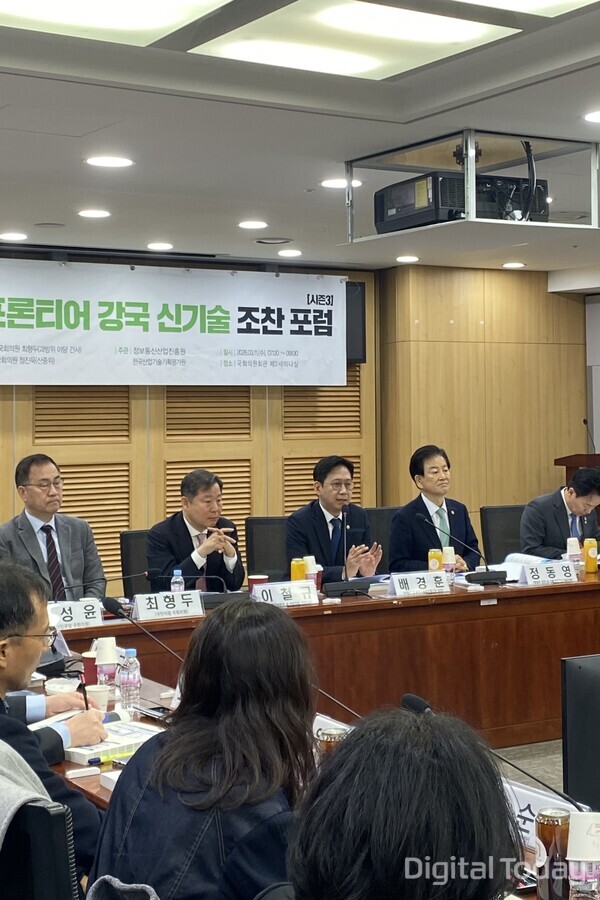
At the "Physical AI Frontier Powerhouse New Technology Breakfast Forum" held on March 11 at the National Assembly Members' Office Building in Yeouido, Deputy Prime Minister Bae Kyung-hoon (배경훈) said physical AI must be properly prepared for the country to build on its capabilities as a manufacturing power. He stressed the need to build capabilities from a full-stack perspective, including world models, physical AI foundation models and smart factory design. He said the government will provide as much support as possible, from national R&D to field applications.
The "Physical AI Frontier Powerhouse New Technology Breakfast Forum" is a network forum in which about 30 experts from industry, academia, research institutions and government participate, with the goal of building a global physical AI powerhouse and establishing technological leadership. The event was run in an all-participants discussion format for 60 minutes, chaired by Unification Minister Jeong Dong-young (정동영).
Lee Do-gyu (이도규), director general for telecommunications policy at the Ministry of Science and ICT, said South Korea has experience and know-how accumulated over decades by skilled craftsmen at manufacturing sites that are among the best in the world, even though the country has not yet digitised such data. He said combining that with independent AI capabilities in an organic way could create physical AI that leads the world. He said the United States is securing leadership in physical AI platforms led by big tech companies such as Tesla and Nvidia, while China has overwhelming mass-production capacity, accounting for about 87 percent of global humanoid shipments. He stressed that this is a time when South Korea urgently needs an agile and strategic response.
The government plans to secure independent common foundational technologies for physical AI within 3 years. It plans to pursue building a data pipeline to digitise craftsmen's know-how at manufacturing sites, developing AI models for robots, developing world models to generate synthetic data for virtual environments, developing high-performance low-power computing platforms, developing foundational humanoid technologies, developing core AI technologies based on physical laws and supporting cooperation between global AI companies and South Korean companies.
In industry, calls continued for building a collaborative ecosystem to commercialise physical AI and for expanding investment in on-device semiconductors.
Kim Min-pyo (김민표), CEO of Doosan Robotics, said the importance of on-device AI semiconductors will grow by the day as physical AI spreads. He proposed that flagship projects should formally include efforts so that collaborative robots equipped with AI can be deployed directly at manufacturing sites. He also asked for a sandbox system so that work safety and industrial safety certification for AI-equipped robots can be steadily expanded.
Seo Young-woo (서영우), executive vice president at Hanwha Aerospace, agreed with the government's direction on building a data pipeline but said the goal is not data collection and the entire structure must be in place to lead to actual learning and actions. He said the current policy lacks development of an action model corresponding to the action step in the three stages of robot perception, thinking and action, and stressed that this should be supplemented.
Cho Young-ho (조영호), vice president at DeepX, stressed the need for low-power on-device semiconductors, saying the physical AI era will be one in which AI runs across industrial sites without cloud infrastructure. He said now is an opportune time for South Korean companies to secure leadership because there is no global market leader yet, and he said it is urgent to create a structure in which semiconductor fabless firms, software companies and demand-side companies collaborate to build real commercial references.
Rebellion highlighted the potential for using server-type NPUs in physical AI. Kim Young-shin (김영신), a director at Rebellion, said people often think first of edge-type NPUs when considering physical AI, but server-type systems can also do many things, including large-scale inference, risk-situation simulations and synthetic data generation. He said the company supports the Cosmos model and is preparing in earnest for the physical AI sector.
Exem called for designing government-level incentives to digitise craftsmen's know-how. Ko Pyeong-seok (고평석), CEO of Exem, said it is important for companies in the national ecosystem to make broad use of the tacit knowledge and know-how held by craftsmen at manufacturing sites, and that there needs to be a policy that boldly provides concrete and practical incentives to draw it out.
The forum was attended by Bae, Jeong, Lee, Kim Seong-yeol (김성열) from the Ministry of Trade, Industry and Energy, Democratic Party lawmaker Jeong Jin-wook (정진욱) and People Power Party lawmakers Choi Hyeong-du (최형두) and Lee Cheol-gyu (이철규). From industry, attendees included Nine Eyes, Naver, Doosan Robotics, Dmillion, DeepX, Robotware AI, Robros, Rebellion, Realworld, Maum AI, MindLogic, Mobilint, Ceragem, Superb AI, SphereAX, Exem, Persona AI, Flitto, Hanwha Aerospace, KT, LG AI Research, LG CNS, NC AI and SKT.
 Seulgi Son
sageson@d-today.co.kr
Seulgi Son
sageson@d-today.co.kr