
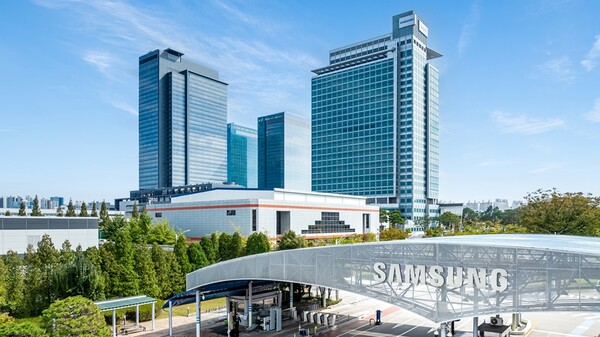
Samsung Electronics' average annual pay per employee hit a record high last year. In its 2025 business report released on March 10, Samsung Electronics said average pay per employee last year was tallied at 158 million won. That was up 28 million won, or 21.5 percent, from 130 million won a year earlier. It was analysed as a result of a recovery in results driven by growth in the AI semiconductor market leading to expanded performance bonuses.
Average compensation for 9 people including registered directors and audit committee members was 3.01 billion won. Average compensation for 3 registered directors was tallied at 8.3 billion won. By individual, the late former vice chairman Han Jong-hee (한종희) was the highest at 13.4 billion won, including 8.56 billion won in severance pay. Chief executive Jun Young-hyun (전영현) received a total of 5.6 billion won, including 1.71 billion won in salary and 3.58 billion won in bonuses. Meeting DS division targets for sales and operating profit, and expanded sales of high value-added products including server DRAM and high bandwidth memory (HBM), were reflected in bonus calculations. Chief executive Roh Tae-moon (노태문) received 6.13 billion won. Achieving DX division sales of 188 trillion won and operating profit of 12.9 trillion won, and slim technology innovation, were included in the assessment.
Among the top 5 recipients of at least 500 million won, Lee Won-jin (이원진) was second-highest at 7.31 billion won. That included 3.46 billion won in salary and 3.76 billion won in bonuses. Adviser Jun Kyung-hoon (전경훈) received 6.42 billion won and adviser Shin Myung-hoon (신명훈) received 6.33 billion won. Their compensation included severance pay of 3.38 billion won and 4.58 billion won, respectively. Based on recurring compensation excluding severance, Lee was the highest. For reference, Samsung Electronics Chairman Lee Jae-yong (이재용) is a non-registered executive as of 2025.
Samsung Electronics also disclosed the scale of benefits from its performance share unit (PSU) scheme introduced in October last year. At the time, the company agreed to provide a total of 35,292,600 common shares to all 128,322 incumbent employees. The average was about 275 shares per person.
PSUs grant a benchmark number of shares by job grade, but whether shares are ultimately delivered and the amount are determined after 3 years depending on the share-price appreciation rate, in a results and share-price-linked compensation structure. The company said the number can be adjusted up or down depending on management roles, taking into account individual performance and activities to enhance corporate value.
Confirmed PSUs are due to be delivered in installments over 3 years from October 2028. If the share price at delivery is lower than at the time of agreement, the number of shares delivered is reduced by that amount. Samsung Electronics said the purpose of introducing the PSU scheme was to strengthen responsible management for employees' mid- to long-term business performance and to enhance shareholder value.
Separately from PSUs, Samsung Electronics operates stock-based compensation schemes. In January this year, it agreed to provide 1,152,022 restricted stock (RSA) shares to 1,051 executives as part of 2024 performance incentives. Long-term incentive (LTI) compensation is also operated separately. Combining agreements made in July last year and January this year, shares amounting to several hundred thousand for several hundred people including executives are due to be delivered in sequence over 2025 to 2028. The company explained that these stock compensation schemes function as a mid- to long-term compensation system that complements short-term cash performance bonuses, raising employees' long-term responsibility for and understanding of company performance.
 Daegeon Seok
d2dg@d-today.co.kr
Daegeon Seok
d2dg@d-today.co.kr